The Future of Government Agencies and Social Media


In 2025, the relationship between government agencies and social media has completely transformed. What began as casual experiments has evolved into a critical public service tool requiring strategy, skill, and quick thinking.
The use of social media by government officials isn’t just about posting updates—it’s about managing sensitive information, choosing the right social media channel, and crafting every social media post with care.
With AI, algorithm shifts, and fake news in the mix, how agencies navigate this new landscape could define the future of public trust.
Key Takeaways:
Building Trust and Transparency in Government Social Media
If you’re running a government agency’s social media, you’re not just posting updates… you’re shaping public trust.
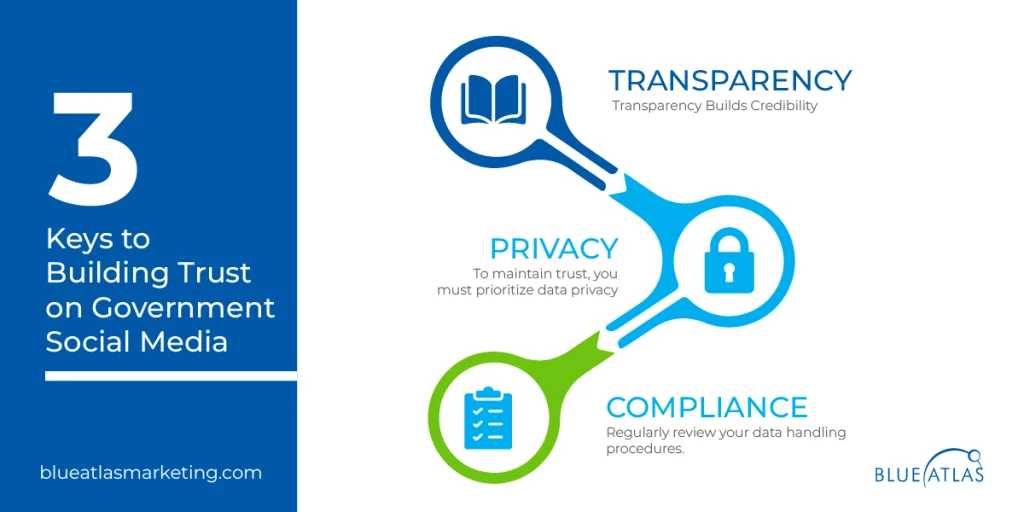
Show, Don’t Just Tell: Transparency Builds Credibility
Citizens are more likely to trust your agency when they actually see what you’re doing, not just hear about it later.
A study found that over 40% of people had never seen a government website or heard of its transparency commitments. That’s not a small gap–that’s a massive opportunity.
When the same people were shown this information clearly and directly, their perception of government transparency improved significantly, no matter if the messaging was framed around efficiency or empathy.
This should be a wake-up call. Don’t assume the public is finding your reports or policies on their own.
If you want to build trust, make transparency easy to see and hard to miss.
Use social posts to highlight decisions in real time, turn dense updates into carousels or reels, and pin important content where it gets noticed.
If your agency keeps the public in the loop, they’ll be far more likely to give you the benefit of the doubt when it counts.
Privacy Isn’t Optional, It’s Expected
With data breaches making headlines, citizens are more cautious than ever.
As reported by TechTarget, the U.S. government’s ban on TikTok from official devices in 2022 highlighted concerns about foreign access to sensitive data.
To maintain trust, your agency must prioritize data privacy.
Be transparent about how you handle user data and ensure that your social media practices align with privacy expectations.
Your audience wants reassurance that their information won’t be misused.
Make it clear what data you collect, why you collect it, and how it’s stored or protected.
Avoid shady tracking tactics and never request more information than needed.
Trust takes time to earn, and one misstep in privacy can cost you the public’s confidence.
Stay Compliant and Know the Rules
Compliance isn’t just a legal requirement but can be a great trust builder.
The Privacy Act of 1974 mandates that federal agencies protect personal information and be transparent about data collection practices.
Ensure your social media activities adhere to these regulations.
Regularly review your data handling procedures and provide clear information to the public about their rights and your responsibilities.
Even seemingly harmless content can become risky if it violates privacy or recordkeeping laws.
Train your team to spot red flags and respond to compliance updates. Make internal policies public when you can—it shows accountability.
Your followers may not always know the law, but they’ll notice when you follow it.
AI and Automation: Revolutionizing Government Social Media Management
AI isn’t science fiction anymore. Suddenly, your agency’s content assistant, customer service rep, and policy checker are all rolled into one.
The AI Toolkit
If you’re still manually scheduling posts and reading every comment, AI could be saving your team hours each week. Here’s how tools are reshaping your workflow.
Content Creation
AI tools can now generate post captions, graphics, and even video transcripts in minutes.
You get real-time insights on what’s trending in your community, so your team knows when to post and what to say.
Instead of reinventing the wheel, AI helps your agency stay timely and relevant–without burning out your comms staff.
Public Engagement
You can stop guessing what your followers want.
AI reads the room through sentiment analysis, letting you know what people are loving—or hating—about your latest post.
Plus, tools that personalize replies or messages (based on user interactions) help your agency feel more human without the effort.
Compliance Support
Content governance is no joke in government. AI now flags posts that could trigger privacy concerns or violate platform policies. It also helps organize and log communications for recordkeeping. That means less time stressing over red tape—and more time actually engaging the public.
AI in Action
You don’t need a futuristic tech stack to see real benefits from AI. Here’s how a smart process might look for your team:
- Automate your content calendar – AI tools suggest optimal times to post and even queue up content from past campaigns that still perform well.
- Chatbots handle FAQs 24/7 – From trash pickup to vaccine info, chatbots give residents instant answers—no staff required.
- Read the mood – AI scans social comments and replies for public sentiment. You’ll know fast if a message is landing wrong.
- Smart analytics = smarter services – Predictive tools help forecast public needs, like flu season surges or extreme weather prep.
- Go multilingual – AI-powered translation breaks language barriers, so your messages reach more people—without hiring a full translation team.
AI Ethics
With all this automation, don’t forget—just because you can doesn’t mean you should. Ethical AI use isn’t optional in public service.
Your community expects transparency, fairness, and accountability. That means using tools that explain how decisions are made.
Making sure your data sets don’t reinforce bias. Getting consent when you collect information.
And developing policies that actually reflect your values. Your AI should work for your community, not just for your efficiency metrics.
Tips for Government Agencies on Social Media
If you’re going to be on social media, be good at it. These platform-specific moves help your team stay strategic, not just reactive.
| Platform | Format Variety | Events / Live Use | Engagement Tactics | Content Style / Tools | Accessibility / Visual Branding |
|---|---|---|---|---|---|
| Use videos, photos, links, and carousels for variety | Promote with the Events tool, stream with Facebook Live | Reply to comments, ask questions in captions | Pin urgent updates for visibility | Keep layout clean, use readable text, and summarize info clearly | |
| X (Twitter) | Post single tweets, threads, and quick links | Live-tweet events or press briefings in real time | Use @mentions, quote tweets, and targeted replies | Focus on high-traffic timing and threading key info | Use strong visuals and plain text to boost clarity |
| Alternate images, Reels, carousels, Stories | Post real-time updates in Stories, recap events visually | Use polls, sliders, Q&As in Stories to spark replies | Keep a consistent look with logo placement and tone | Add alt-text, stick to branded templates and color schemes | |
| TikTok | Create bite-sized explainers, staff features, trending cuts | Not live-focused, but use trends to boost civic content | Engage through duets, respond to comments with video replies | Use tools like Footnotes to add extra value | Include captions, keep design native to TikTok, use real people over graphics |
Emerging Technologies and Trends in Government Social Media

You don’t need to go full Metaverse, but ignoring emerging tech could cost your agency future engagement. Here’s what’s already gaining ground:
- Augmented Reality (AR) can help with things like interactive maps, real-time voting tutorials, or location-based alerts at community events.
- Virtual Reality (VR) is being used for immersive town halls, training simulations, or even virtual civic tours.
- AI-powered avatars and digital twins are making it easier to simulate citizen services and test user experience without real-world risks.
- Metaverse presence is already being explored for engaging hard-to-reach audiences in controlled virtual environments.
- Blockchain tools may soon help verify communications—think public notices with built-in authenticity you can’t fake or alter.
None of this means your agency has to reinvent itself but you should definitely be experimenting.
How to Stay Ahead of Social Media Trends
Staying current doesn’t have to feel like chasing a moving target:
Step 1: Monitor new platforms and watch how other civic orgs use them. Be early, not last.
Step 2: Partner with content creators who align with your mission—they know how to keep things fresh.
Step 3: Train your staff consistently. Tools change monthly—don’t get stuck in 2018 tactics.
Step 4: Try AI tools for analytics, planning, and copy help. They won’t replace your team, but they’ll make life easier.
Step 5: Collaborate across agencies. Share wins, templates, and data—it levels everyone up.
Step 6: Track performance metrics regularly. Let data guide the strategy, not guesswork.
Frequently Asked Questions (FAQs)
How can AI improve social media engagement for government agencies?
AI enhances engagement by automating tasks, analyzing trends, and personalizing video content to better meet citizen needs across multiple platforms.
What are the best practices for building trust on government social media platforms?
Transparency, consistent communication, and safeguarding privacy are key to fostering trust with social media users
What role does data security play in government social media management?
Ensuring the security of user data is essential to protect privacy and comply with government regulations on the use of their data.
How can government agencies create an effective social media strategy?
Agencies should tailor their strategy to specific social platforms, create engaging social media content, and track engagement metrics to optimize performance.
What emerging trends will shape government social media by 2025?
The integration of AR, VR, and AI will revolutionize how government agencies in the United States interact with citizens on social media.
Takeaway
For government agencies and social media, the goal goes far beyond gaining likes—it’s about delivering real public service, building visibility, and earning trust. As social platforms evolve and AI reshapes strategies, maintaining strong, responsive social media accounts is more important than ever.
Agencies that adapt quickly, invest in training, and listen actively will strengthen their social media presence and stay connected to the communities they serve. The digital future is already moving—and so are the expectations of your citizens.
Is your social media aligned with trends?
Ready to level up your social media strategy? Contact us today!
We specialize in helping government agencies optimize their social media, making it smarter, more secure, and prepared for the future!