
Website Accessibility for School Districts
Title II sets a firm WCAG 2.1 AA standard for district and school websites. We audit, remediate, and monitor the portals, forms, and documents students and families use every day.


Compliance Built for District and School Sites
A school district rarely runs one website. It runs a district site plus a site for every school, maintained by staff across dozens of buildings who publish content daily: enrollment and registration forms, parent portals, board policies and agendas, calendars, lunch menus, newsletters, and classroom materials. Accessibility barriers get introduced at that scale faster than any single team can catch them. Schools have also been a focus of enforcement for years, with the U.S. Department of Education’s Office for Civil Rights (OCR) taking website-accessibility complaints and entering resolution agreements that require districts to bring their sites to WCAG conformance. We work in these sites every day and know what Title II asks of them.
Certified Accessibility Specialists
In-house
Development Team
15+ Years Building and Maintaining Websites
Your Title II Deadline
In April 2026, the Department of Justice extended its Title II web accessibility deadlines by one year. The dates moved, but the obligation did not.

Districts serving a population of 50,000 or more: conform to WCAG 2.1 AA by April 26, 2027.


Districts serving fewer than 50,000: conform by April 26, 2028.

Across a district site, multiple school sites, and years of uploaded documents, that runway is shorter than it looks. An audit is the first step, because you cannot budget or fix what you have not measured.
Where District Sites Fall Short
The 2026 WebAIM Million study found detectable WCAG failures on 95.9% of the top one million home pages, and the rate has risen year over year. On district sites, the issues concentrate in a few predictable places:
Automated tools catch only about a third of these. The rest surface when a specialist tests the site with the assistive technology students and families actually use.
What Your EdTech and Platform Vendors Don’t Cover
Districts lean on third-party tools: the website platform, the SIS, the LMS, payment and registration systems, and classroom apps. A vendor covering accessibility for its own product does not make the content your staff add accessible, and it does not remove the district’s responsibility for the experience you point families to. When you procure a tool, ask for its accessibility conformance report (an ACR built from a VPAT) and put accessibility requirements in the contract. For the content the vendors leave to you, your pages, your uploaded documents, and your custom components, our program covers that gap.
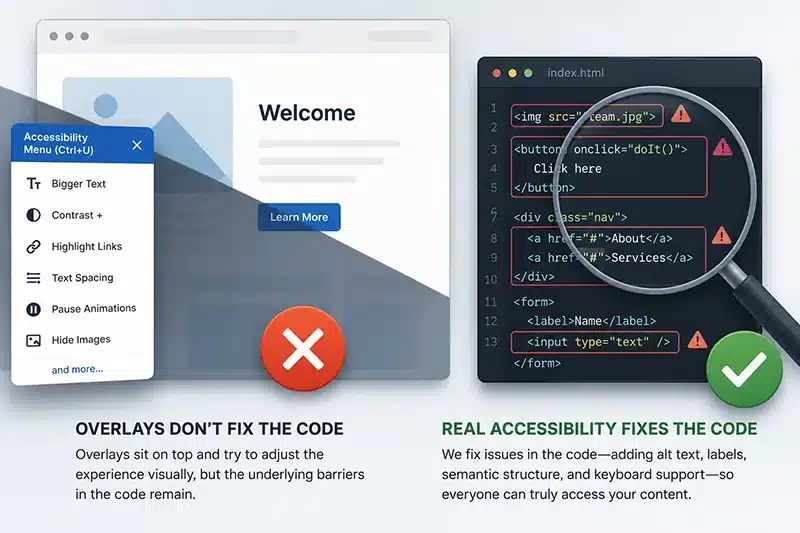
Overlays Don’t Make You Compliant
Accessibility overlays and widgets adjust a page from the outside with a line of JavaScript. They never change the underlying code, so the barriers a screen reader or keyboard user hits remain, and an overlay does not produce the WCAG conformance Title II requires. In 2025, the Federal Trade Commission ordered a leading overlay vendor, accessiBe, to pay $1 million for deceptively claiming its product could make a website compliant. We fix issues in the code, where they actually live.
How We Get Your District Compliant
Title II covers far more than your home page. Our audits can include:
Audit
A manual, expert evaluation against WCAG 2.1 AA. You receive a report your team, leadership, and attorney can use: every issue rated by severity, mapped to its success criterion, with affected pages and developer-ready guidance.
Remediate
Our in-house developers fix the issues in your source code, including the PDFs and forms most vendors skip. We hand your team the fixes or make them for you, then re-test and confirm each one.
Monitor
New pages, uploaded documents, and staff edits reintroduce barriers over time. Our managed program keeps you at WCAG 2.2 AA past the deadline with scheduled monitoring, audits, training, and remediation.
What Compliance Costs
Pricing is scoped to the size and complexity of your sites and their document volume, so you get a fixed, transparent quote before any work begins.
As an industry benchmark, manual audits typically run:
$150 to $500
per page
depending on complexity
Free Audit Option
If Blue Atlas Marketing is utilized for remediation following the human-led audit, we will credit your audit cost towards the total remediation project.
It makes the audit free, since you will need to remediate the issues to expand your websites accessibility and conform to ADA compliance requirements.
Frequently Asked Questions
See where your district stands, at no cost
Start with a free scan for an instant first look, then talk with our team about a full audit and the path to Title II compliance across your district and school sites.
