Creating an Effective Government Agency Social Media Policy


One wrong tweet can trigger public outrage. One vague comment can dominate headlines. In today’s fast-paced digital world, having a strong government agency social media policy isn’t optional—it’s essential.
Social media drives public affairs, fuels collective action, and even shapes policy decisions. Without clear guidelines on social media content, you risk exposing sensitive information and losing public trust.
This guide will walk you through the best practices to create a structured, proactive policy that protects your agency and strengthens your communication efforts.
Key Takeaways:
Why You Can’t Skip the Social Media Policy
Social media for government organizations plays a crucial role in building public trust—it shapes how your agency engages with the community and how citizens hold you accountable.
The growing influence of social media in government communication
Across the globe, people see social media as a tool for democracy. But not everyone trusts it equally.
A recent global survey by PewResearch found that while three out of four people in Singapore believe social media supports democracy, only one in three Americans feel the same.
The message? People are watching. And what your agency posts—or doesn’t—can shape public trust.
Your audience expects instant updates, transparency, and interaction.
That puts pressure on your team to not only speak clearly but to speak responsibly.
A casual post can be misread, misquoted, or misused without guardrails. Even silence can be a problem.
The need for structured policies to guide appropriate social media use
It’s not enough to just have an account—you need clear rules for how it’s used.
A well-written policy protects your agency from real risks, not just bad optics.
It should cover how employees represent the agency online, but also much more.
Think copyright. Think privacy. Think misinformation. Structured policies help your agency avoid legal traps like defamation, unauthorized use of content, or sharing protected data.
They also establish protocols to handle cyberbullying, online harassment, and even cases of discriminatory behavior on your channels.
These aren’t fringe concerns… they’re part of daily operations now.
Social media may feel informal, but when a government account posts something, it carries weight.
Without a regulatory framework, you leave too much to chance.
That’s why it is safe to say that with a clear policy, you protect your staff, your constituents, and your credibility.
What Every Policy Should Actually Include
You’ve got the accounts and the audience. Now it’s time to build a policy that actually works–one that supports your goals and protects your team.
Establishing clear objectives for social media use in government settings
Start with the why. What’s the point of your agency being on social media in the first place?
Your objectives should tie directly to your agency’s mission, whether that’s promoting public services, answering community questions, or improving transparency.
Don’t just post to post. Define your key focus areas. If your goal is public education, your content should reflect that.
If it’s an emergency response, your tone and timing matter even more.
When your team knows what success looks like, they’ll know what to aim for and what to avoid.
Defining employee conduct for both official and personal use of social media
Your team wears two hats online: personal and professional. Your policy should address both.
For official posts, the standard is high. Employees must represent the agency with professionalism, accuracy, and neutrality.
No biased commentary. No off-the-cuff jokes.
For personal accounts, freedom of speech still applies, but with caution.
Even off-duty posts can damage public trust if they appear to reflect agency positions or reveal confidential details.
Set expectations early to avoid future issues.
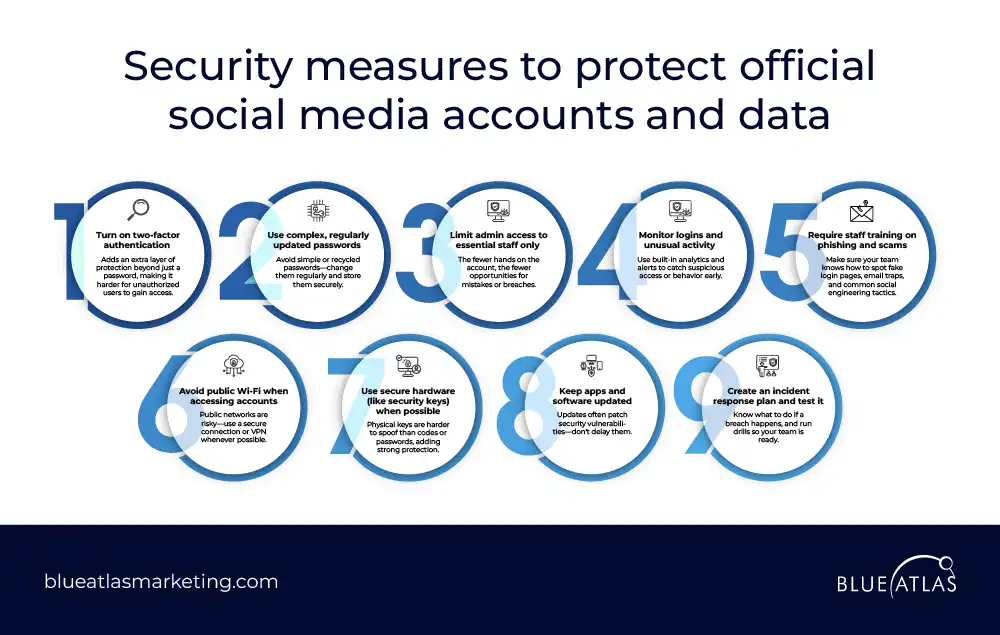
Security measures to protect official social media accounts and data
Security isn’t optional—it’s your first defense. Follow these steps:
- Turn on two-factor authentication – Adds an extra layer of protection beyond just a password, making it harder for unauthorized users to gain access.
- Use complex, regularly updated passwords – Avoid simple or recycled passwords—change them regularly and store them securely.
- Limit admin access to essential staff only – The fewer hands on the account, the fewer opportunities for mistakes or breaches.
- Monitor logins and unusual activity – Use built-in analytics and alerts to catch suspicious access or behavior early.
- Require staff training on phishing and scams – Make sure your team knows how to spot fake login pages, email traps, and common social engineering tactics.
- Avoid public Wi-Fi when accessing accounts – Public networks are risky—use a secure connection or VPN whenever possible.
- Use secure hardware (like security keys) when possible – Physical keys are harder to spoof than codes or passwords, adding strong protection.
- Keep apps and software updated – Updates often patch security vulnerabilities—don’t delay them.
- Create an incident response plan and test it – Know what to do if a breach happens, and run drills so your team is ready.
Structuring the Approval and Management of Social Media Accounts
Managing government social media accounts starts with a process—one that ensures both consistency and compliance.
Establishing a process for approving new government social media accounts
Before you create a new social media account, take a step back.
You need a formal process. Start by asking whether the account is really necessary.
If it is, get the necessary approvals from the right people. This isn’t a one-person decision.
Then, assign the account to someone responsible for managing it. It’s crucial that they understand both your agency’s goals and the platform’s capabilities.
Next, implement training and compliance measures so everyone is on the same page.
Register and document the account to ensure transparency and accountability.
Finally, set clear content and engagement guidelines, like how often will you post? What tone should you use?
And remember! This process doesn’t end once the account is live.
Ongoing monitoring and performance reviews are key to maintaining a successful social media presence.
Assigning roles for content creation and content moderation
Your social media strategy needs people who know what they’re doing.
For content creation, your goal should be to inform, educate, and engage the public.
The person in charge should be active on social media, understand trends, and possess strong logical and empathetic communication skills.
Their job is to make sure your messages resonate and help build public trust.
But it doesn’t just stop there. Content moderation is just as important.
You need someone to monitor user-generated content, ensuring everything aligns with your community guidelines.
This person must know how to handle offensive, misleading, or inappropriate posts and should have experience in moderating content, preferably with a background in business process outsourcing (BPO) or social media moderation.
Content Moderation, Engagement, and Privacy Considerations
Managing social media for government agencies goes beyond simply sharing updates—it’s about fostering a respectful, secure environment while carefully adhering to privacy laws and platform policies.
You can’t just let anything fly online. Social media platforms have strict guidelines to protect users from harmful content like hate speech or violence, and you need to enforce them too.
While each platform has its own moderation standards, they all work to filter out harmful content.
For example, Meta’s systems recently removed 90% of violent and graphic content and 86% of bullying and harassment on Instagram in the European Union.
The lesson here? Automating this process helps but doesn’t replace human oversight.
Your policy should set clear expectations for what’s acceptable on your accounts and how your team will handle flagged content.
Addressing privacy concerns and adhering to platform-specific privacy policies
Each platform has its own rules. What works on one may get flagged or misunderstood on another. Here’s a quick guide:
- Facebook: Privacy settings are customizable, but user interaction is wide open. Monitor comments and use moderation tools for public-facing posts.
- Instagram: Focuses heavily on visual content. Stories disappear, but screenshots don’t. Be cautious with what you share, especially in DMs.
- X (Twitter): Known for rapid updates and public replies. Be clear and concise, but avoid responding emotionally. All replies are public unless locked.
- TikTok: Short videos can spread fast. Be sure your message is fully vetted before posting, and disable duets or stitches if needed.
- YouTube: Long-form content invites long-form comments. Use filters and moderation settings to manage spam and harmful remarks.
- Threads: Newer platform with Instagram-style posting but more text-heavy. Policies are still evolving—monitor closely.
- LinkedIn: Professional tone is expected. Avoid political or overly casual content, and use discretion when sharing agency updates.
Defining acceptable conduct and content standards for social media users
Your policy should clearly state the dos and don’ts for your team and the public. Here’s a guide to follow:
| Standard | Do | Don’t |
|---|---|---|
| 1. Maintain Professionalism | Stay respectful and calm, even when responding to criticism. | Avoid sarcasm, insults, or combative replies. |
| 2. Respect Privacy | Keep personal data out of public replies and comment threads. | Never post or request sensitive personal information. |
| 3. Stay Neutral | Stick to public service topics and agency updates. | Don’t promote political campaigns or opinions. |
| 4. Avoid Commercial Endorsements | Share services only when relevant and approved. | Don’t promote private businesses or paid content. |
| 5. Focus on Facts | Post verified, accurate, and timely information. | Don’t speculate, guess, or share rumors. |
| 6. Engage Constructively | Encourage positive and solution-focused dialogue. | Don’t escalate heated conversations or respond emotionally. |
| 7. Use Hashtags and Tags Wisely | Tag relevant agencies and use clear, relevant hashtags. | Avoid over-tagging or using hashtags unrelated to the content. |
| 8. Post Mindfully | Consider timing, frequency, and relevance before hitting “publish.” | Don’t flood timelines with back-to-back posts. |
| 9. Shorten and Clarify Links | Use secure, shortened links to improve accessibility. | Don’t share long or suspicious-looking URLs. |
Ensuring Compliance and Policy Enforcement
A social media policy only works if it’s followed, and that means building systems that hold people accountable.
Start by setting clear goals tied to your agency’s mission.
What are you trying to accomplish—better public engagement, faster emergency communication, improved trust?
Once you know the “why,” track how well your social content supports it.
Use monitoring tools that help your team spot issues early, like off-brand messaging, unauthorized posts, or public pushback.
You don’t need to micromanage, but you do need a structure.
Define how violations are identified, who reviews them, and how often you evaluate your efforts.
Build a reporting process that connects activity to key performance indicators (KPIs), so you can measure what matters.
Social media is fast. Your compliance process needs to keep up.
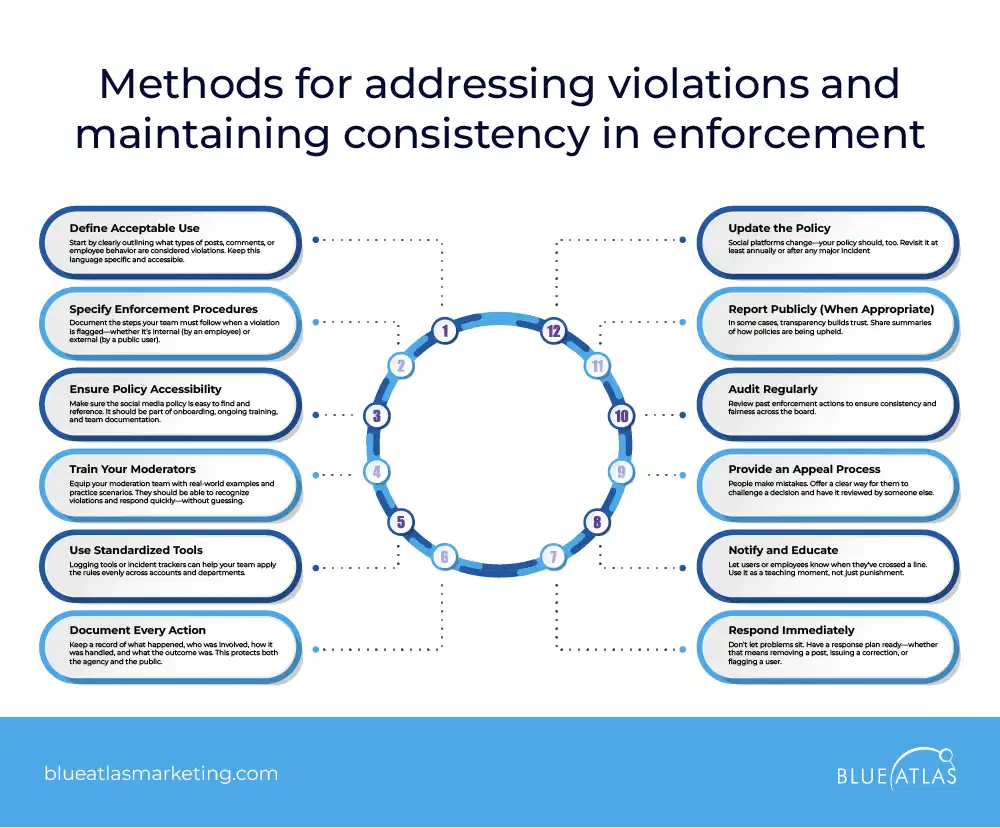
Methods for addressing violations and maintaining consistency in enforcement
To respond to policy violations effectively, your process should be structured, repeatable, and fair. Here’s how to do it:
- Define Acceptable Use. Start by clearly outlining what types of posts, comments, or employee behavior are considered violations. Keep this language specific and accessible.
- Specify Enforcement Procedures. Document the steps your team must follow when a violation is flagged—whether it’s internal (by an employee) or external (by a public user).
- Ensure Policy Accessibility. Make sure the social media policy is easy to find and reference. It should be part of onboarding, ongoing training, and team documentation.
- Train Your Moderators. Equip your moderation team with real-world examples and practice scenarios. They should be able to recognize violations and respond quickly—without guessing.
- Use Standardized Tools. Logging tools or incident trackers can help your team apply the rules evenly across accounts and departments.
- Document Every Action. Keep a record of what happened, who was involved, how it was handled, and what the outcome was. This protects both the agency and the public.
- Respond Immediately. Don’t let problems sit. Have a response plan ready—whether that means removing a post, issuing a correction, or flagging a user.
- Notify and Educate. Let users or employees know when they’ve crossed a line. Use it as a teaching moment, not just punishment.
- Provide an Appeal Process. People make mistakes. Offer a clear way for them to challenge a decision and have it reviewed by someone else.
- Audit Regularly. Review past enforcement actions to ensure consistency and fairness across the board.
- Report Publicly (When Appropriate). In some cases, transparency builds trust. Share summaries of how policies are being upheld.
- Update the Policy. Social platforms change—your policy should, too. Revisit it at least annually or after any major incident
Frequently Asked Questions (FAQs)
Do all government agencies need a social media policy?
Yes—regardless of size. In the United States, a social media policy protects your agency, staff, and public trust by setting clear standards for public communications.
How often should we update our policy?
At least once a year, or whenever changes in social media content guidelines, platform rules, or internal priorities occur to ensure ongoing compliance.
Can employees post about work on personal accounts?
They can, but posts must be handled with care. Social media managers should remind staff to avoid sharing anything that compromises credibility or breaches confidentiality.
What should be included in a social media audit?
A thorough audit should review account activity, access controls, content accuracy, and compliance with established standards for responsible public communications.
Who should manage agency accounts?
Agency accounts should be managed by trained social media managers skilled in communication, platform moderation, and navigating the specific needs of public communications.
Even the best-written government agency social media policy won’t make an impact if your staff isn’t aware of it or doesn’t know how to apply it. Regular training keeps everyone aligned and confident in what they post.
But your work doesn’t end there. Social media evolves fast, and so should your policy. Set a schedule for reviewing and updating it, so you’re always prepared—not left playing catch-up.
How can Blue Atlas Marketing help you?
Transform your social media strategy with our marketing services for district or government agencies. Start building an effective policy today.
Let’s talk about how to strengthen your strategy. Contact us today to get started!