
ADA Website Compliance for Municipalities
Title II now sets a firm WCAG 2.1 AA standard for city and county websites. We audit, remediate, and monitor municipal sites so your residents can use them and your compliance is documented.


Compliance Built for City and County Sites
Municipal websites carry a specific kind of load: thousands of pages, a deep library of agendas and meeting minutes, board packets, permits, and the online forms residents use to pay bills and request services. That is exactly where accessibility problems concentrate, and it is where a generic scan falls short. We work in these sites every day and know what Title II requires of them.
Certified Accessibility Specialists
In-house
Development Team
15+ Years Building and Maintaining Websites
Your Title II Deadline
In April 2026, the Department of Justice extended its Title II web accessibility deadlines by one year. The dates moved, but the obligation did not.

Serving 50,000 or more residents (most cities, counties, universities, and larger community colleges): conform to WCAG 2.1 AA by April 26, 2027.


Serving under 50,000, or any special district government: conform by April 26, 2028.

On a site with thousands of pages and years of documents, and a procurement cycle in front of any contract, that runway is shorter than it looks. An audit is the first step, because you cannot budget or fix what you have not measured.
Where Municipal Sites Fall Short
The 2026 WebAIM Million study found detectable WCAG failures on 95.9% of the top one million home pages. On municipal sites, the issues cluster in a few predictable places:
Automated tools catch only about a third of these. The rest surface when a specialist tests the site with the assistive technology residents actually use.
What Your Website Platform Doesn’t Cover
If your site runs on a hosted government platform such as CivicPlus, Granicus, or Revize, its built-in accessibility features cover the platform’s own templates and core code. The content your team adds sits outside that: your pages, custom components, and the PDFs and documents staff upload every week. The platform vendors say so in their own terms, and that content is where most violations live. Our program covers exactly that gap.
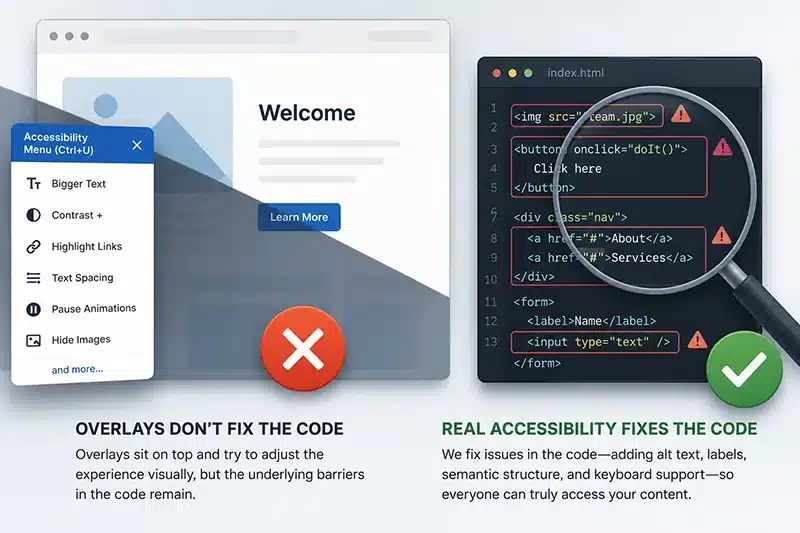
Overlays Don’t Make You Compliant
Accessibility overlays and widgets adjust a page from the outside with a line of JavaScript. They never change the underlying code, so the barriers a screen reader or keyboard user hits remain, and an overlay does not produce the WCAG conformance Title II requires. In 2025, the Federal Trade Commission ordered a leading overlay vendor, accessiBe, to pay $1 million for deceptively claiming its product could make a website compliant. We fix issues in the code, where they actually live.
How We Get Your City Compliant
Title II covers far more than your home page. Our audits can include:
Audit
A manual, expert evaluation against WCAG 2.1 AA. You receive a report your team, leadership, and attorney can use: every issue rated by severity, mapped to its success criterion, with affected pages and developer-ready guidance.
Remediate
Our in-house developers fix the issues in your source code, including the PDFs and documents most vendors skip. We hand your team the fixes or make them for you, then re-test and confirm each one.
Monitor
New pages, uploaded PDFs, and plugin updates reintroduce barriers over time. Our managed program keeps you at WCAG 2.1 AA past the deadline with scheduled monitoring, audits, training, and remediation.
What Compliance Costs
Pricing is scoped to the size and complexity of your site and its document volume, so you get a fixed, transparent quote before any work begins.
As an industry benchmark, manual audits typically run:
$150 to $500
per page
depending on complexity
Free Audit Option
If Blue Atlas Marketing is utilized for remediation following the human-led audit, we will credit your audit cost towards the total remediation project.
It makes the audit free, since you will need to remediate the issues to expand your websites accessibility and conform to ADA compliance requirements.
Frequently Asked Questions
See where your city stands, at no cost
Start with a free scan for an instant first look, then talk with our team about a full audit and the path to Title II compliance.
