After Fashion Nova: The DOJ Is Forcing Accessibility Settlements to Have Teeth

Want to hear an audio version of this article? Click the play button below.
A February 2026 DOJ filing signals that paying without fixing is no longer enough.
For two decades, the playbook for ADA web accessibility settlements looked the same. A demand letter arrives. Attorneys negotiate a settlement. A payment changes hands. The site gets a vague pledge of improvement. Everyone moves on.
That playbook just got rewritten.
In February 2026, the Department of Justice filed a Statement of Interest in ‘Alcazar v. Fashion Nova, Inc.,’ urging a California federal court to reject a proposed multi-million-dollar class settlement. The case was brought on behalf of blind users who could not navigate the retailer’s website. The injunctive relief, the DOJ argued, was too vague to deliver actual access. The court held an evidentiary hearing on March 30, 2026.
Then came the detail that made the filing land. The website set up to manage the settlement claims was itself inaccessible to screen reader users.
What the DOJ Said Was Missing
According to coverage from Seyfarth Shaw’s ADA Title III Blog, the DOJ’s objections in Fashion Nova zeroed in on four absences:
- No ongoing compliance monitoring
- No staff training program
- No third-party audit requirement
- No annual reporting
Read separately, those four items look like procedural housekeeping. Read together, they describe the structural difference between paying for a problem and fixing one.
“The whole thing about Fashion Nova is that it basically looked like ‘we’re going to force them to pay money that a bunch of attorneys are going to make,’” said Nate Stockard, President at Blue Atlas Marketing. “The DOJ said, hey, the whole point of this lawsuit is that they disenfranchised blind users. You’re making them pay money. You didn’t fix it.”
A Program, Not a Project
The Fashion Nova filing is part of a broader DOJ enforcement posture that treats web accessibility as something an organization sustains, not something it purchases once and forgets.
“You don’t go do an accessibility project. You have an accessibility program,” Nate Stockard said. “People are usually familiar with the ADA through the physical world. They build a bathroom that’s compliant, and unless they renovate, it stays compliant. Websites, PDFs, content, those things can change multiple times a day. That’s why you have to have a program of accessibility instead of a one-time thing.”
The Fashion Nova settlement, in the DOJ’s view, did the opposite. It set up no mechanism to keep the site compliant after the check cleared.
What Changes for Businesses Sued in 2026 and Beyond
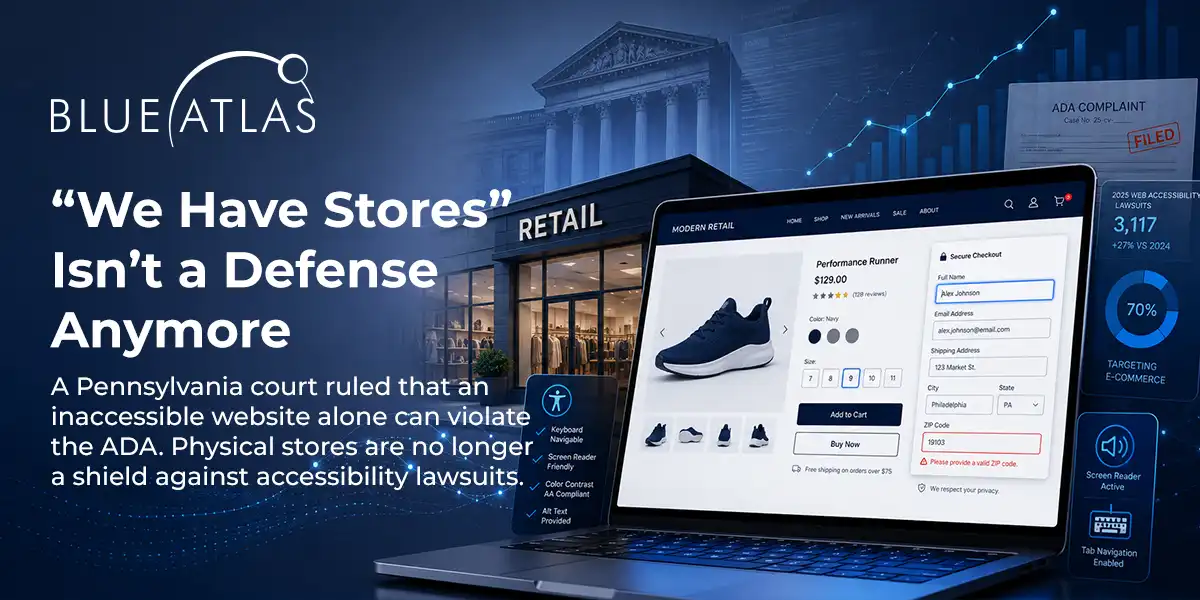
The Fashion Nova intervention did not arrive in a quiet year. According to the 2025 annual count from the ADA Title III Blog, more than 3,100 federal web accessibility lawsuits were filed in 2025, accounting for 36% of all ADA Title III federal filings. Florida nearly doubled its prior year total to 961 cases. Filings have continued to climb into 2026, fueled in part by AI-assisted pro se complaints that lower the cost of bringing a case.
For businesses on the receiving end of a demand letter, the math has changed. A quiet exit with no real remediation may no longer get approved.
“They’re saying let’s look at the law you actually broke,” Nate Stockard said. “You broke a law saying you’re supposed to be accessible. Yes, we’re going to make you pay a fine, but you’re going to have to fix this as well. About 40% of the lawsuits are repeat lawsuits because people paid the fine and never fixed the site.”
The Overlay Problem the DOJ Will Not Solve
A large share of the businesses being sued are not ignoring accessibility. They have already paid for what they were told was a solution.
The AudioEye 2026 Web Accessibility Litigation Report found that nearly 40% of organizations sued for web accessibility violations in 2025 already had an overlay tool installed when the lawsuit was filed. Overlays are the small icons, often a blue figure in the corner of a website, marketed by companies like accessiBe, UserWay, and AudioEye as a path to WCAG compliance.
The Federal Trade Commission has weighed in directly on those claims. In April 2025, the FTC finalized a $1 million order against accessiBe, permanently barring the company from claiming its AI overlay can make any website fully WCAG compliant. The order is tracked by Accessibility.build. More than 600 accessibility professionals have signed a public statement declaring that overlays do not meet legal requirements and frequently make the experience worse for the very people they claim to serve.
Stockard’s view on why overlays remain popular comes down to who is looking at them.
“Why are overlays so successful? Because the user who doesn’t actually need to use assistive technology can see them,” Stockard said. “The people who use assistive technology need programming that the typical user doesn’t see. It’s in the code. Somebody just looking at pretty pictures isn’t going to see what needs to happen in the code to make the site work.”
What a Real Audit Actually Catches
The distinction between an automated scan and a human-led audit matters because much of WCAG 2.1 Level AA cannot be evaluated by software alone.
Stockard uses a common failure point as an illustration. An automated scanner checks whether an image has alternative text. It does not check whether the alternative text is useful.
“The scanner says, oh, you have alt text, you’re good,” Nate Stockard said. “But if the alt text is literally image123.jpg, what did that do for a user who needs a screen reader? They now know you have an image called image123 and it’s a JPEG. A human would say that doesn’t work.”
A meaningful audit is not a scan. It is a code-level review combined with manual testing against the criteria a court will actually consult.
What Public Sector Organizations Should Take From This
The Title II compliance extension issued by the DOJ in April 2026 gave large public entities until April 2027 and smaller ones until April 2028 to meet WCAG 2.1 Level AA. The extension applies only to the DOJ’s own enforcement timeline. Existing ADA effective communication obligations remain in force, and private plaintiffs can sue under those obligations today.
“The biggest thing for organizations that got the extension is, did you realize you can still get sued?” Nate Stockard said. “The DOJ just said they’re not going to come after you until 2027 or 2028. But that’s the DOJ. There are a whole lot of other people in this country who consume your website today and have been able to sue you for several years.”
A real compliance program involves an audit, a remediation cycle, staff training, and ongoing monitoring. Those happen to be the same four elements the DOJ singled out in Fashion Nova.
The Misconception Worth Correcting
If there is a single takeaway from the Fashion Nova filing, it is this: the option to write a check and walk away is closing.
“If you got sued because you didn’t have an ADA-compliant bathroom, you wouldn’t just write a check and say, by the way, we’re not putting one in. I’m just going to write you a check every time,” Nate Stockard said. “That doesn’t make any sense. Why are we doing that digitally?”
The Department of Justice has made its position clear. Courts are listening.
Where Does Your Website Stand?
Blue Atlas Marketing provides ADA accessibility audits and remediation for municipalities, school districts, community colleges, and private businesses subject to Title II and Title III. Our audits go beyond automated scanning to deliver code-level, assistive-technology-tested findings mapped to WCAG 2.1 Level AA.