You Paid for Accessibility. Here’s Why You’re Still Getting Sued.

Want to hear an audio version of this article? Click the play button below.
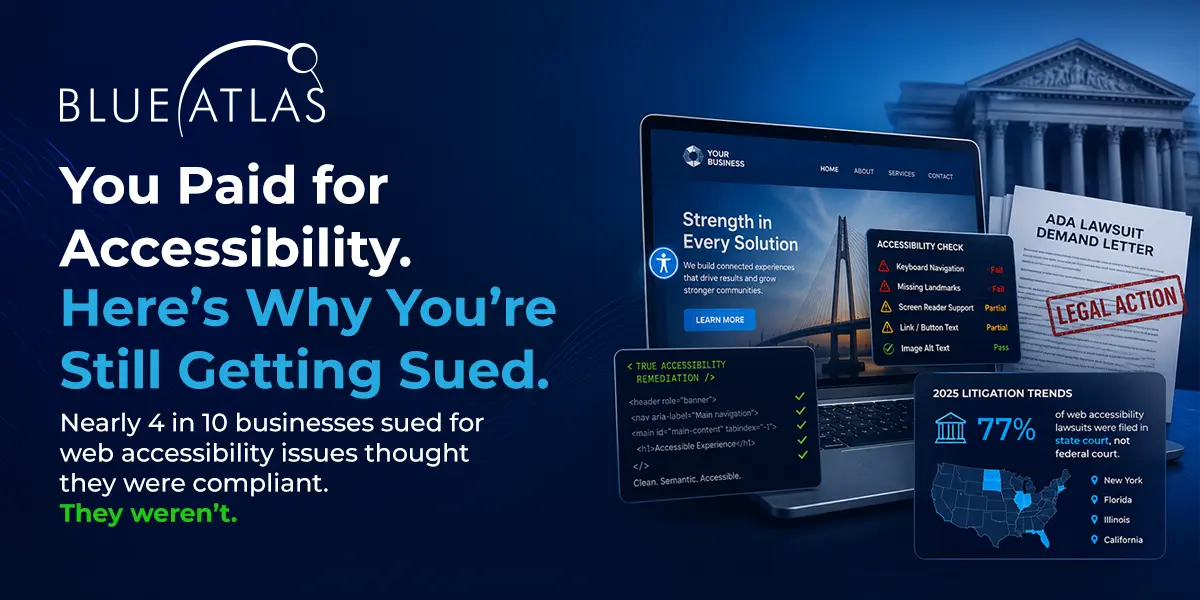
Nearly four in ten businesses sued for web inaccessibility in 2025 already had an accessibility solution installed. A new litigation report explains why that didn’t protect them — and where the lawsuits are going next.
When a business gets hit with a web accessibility lawsuit, the first question is usually: how did this happen? For nearly 40 percent of defendants in 2025, the answer is uncomfortable. They thought they were covered.
According to AudioEye’s 2026 Web Accessibility Litigation Report, 38.5 percent of businesses sued for inaccessibility last year already had some form of accessibility solution in place. In most cases, that solution was an overlay or third-party widget — the kind of tool marketed as a one-line install that brings a site into compliance.
Nate Stockard, President at Blue Atlas Marketing, has seen this gap play out repeatedly with clients. “When you talk about an accessibility solution that’s installed, you’re usually talking about an overlay or a script,” Nate Stockard said. “Because otherwise, you don’t really install a solution. You actually have to change the code and remediate it so the site is genuinely accessible.”
The report’s data makes clear that the legal threat is evolving in ways most organizations haven’t tracked. Total accessibility lawsuits reached 26,253 in 2025, more than double the volume recorded in 2020. And the venue where those cases are being filed has shifted significantly.
The Federal Blind Spot Most Organizations Don’t Know About
The conversation around ADA web accessibility has long centered on federal litigation — Department of Justice enforcement actions, Title III cases in federal court, high-profile class action settlements. That framing misses where the actual volume is building.
Of the 26,253 accessibility lawsuits filed in 2025, only 5,791 were in federal court. The remaining 20,438, or roughly 77 percent, were filed at the state level. State courts are faster to navigate, easier to get settlements in, and in several states, carry damage provisions that far exceed what federal law allows.
“Most of these 20,000-plus cases are happening at the state level,” Nate Stockard said. “State cases are faster to file. Easier to get settlements, easier to get judgments. The serial plaintiffs are going after state court because they can move faster and get paid faster.”
“77% of 2025 web accessibility lawsuits were filed in state court, not federal court“
The financial exposure in state court is real. California’s Unruh Civil Rights Act carries a $4,000 statutory penalty per violation. New York’s Human Rights Law can reach $50,000 to $100,000 per case. Plaintiffs’ attorneys understand this arithmetic well: a demand letter for $25,000 is far cheaper for a defendant than litigating toward a six-figure judgment.
Nate Stockard noted that the organizations most likely to be caught off guard are public entities. “As I talk to schools, cities, counties, municipalities, special districts, most of them continue to talk about the Department of Justice’s requirement deadline that moved, and think that gives them time to not worry about it. No one is really thinking about the state level. And that’s what I think is going to surprise people.”
What Overlays Actually Do — and What They Don’t
The 38.5 percent figure from AudioEye’s report points directly at one category of product: the accessibility overlay. These tools are marketed aggressively, priced low, and install in seconds. The promise is automatic code correction. The reality is considerably more limited.
“There is a place for an overlay,” Nate Stockard said. “It’s useful for a website user who may not have their own assistive technology, who wants to blow up the text or switch to a light background. That’s about as far as these things go.”
“Anyone I know of who has actually gone to the extent of making their website accessible doesn’t need a widget. Because they’ve actually made it accessible according to WCAG standards. Nobody needs a widget to fix your website because your website is already fixed.”
The core problem is structural. An overlay sits on top of existing code and can only manipulate what the underlying site already provides. If the page lacks proper landmark structure, the overlay cannot create it. If a data table has no logical reading order, the overlay cannot determine the correct one. If form fields are missing labels, the overlay cannot supply meaningful ones.
More critically, the tool that is supposed to help screen reader users is often inaccessible to them. “How is someone with a screen reader going to find the widget, click it, and change things so their screen reader can operate properly?” Nate Stockard asked. “Most of the time, these overlays are barely reachable by keyboard at all, without tabbing through an entire section of the website first. The people who actually need the accessibility can’t get to the overlay you think is fixing it for them.”
Blue Atlas was not immune to the overlay pitch. “When we first got into solving accessibility for clients, we thought an accessibility widget would be great,” Nate Stockard said. “We bought into that marketing. But I’ll tell you, we literally bought into it for like two installs and then realized they were not doing what they said they were going to do.”
Fashion Nova’s $5.15 Million Lesson
No case better illustrates the overlay problem than Fashion Nova. A blind shopper sued the retailer in 2020 over a screen-reader-incompatible site. After five years of litigation, the case settled for $5.15 million, with California class members eligible to claim up to $4,000 each.
Then the Department of Justice intervened, filing a Statement of Interest urging the court to reject the settlement. The DOJ’s objection was pointed: the deal enriched plaintiff’s counsel while delivering little of lasting value and no enforceable mechanism to keep Fashion Nova’s site compliant. The DOJ also noted that the plaintiffs’ own settlement website, the page built to manage claims in an accessibility case, was running a UserWay overlay and was itself inaccessible to screen reader users.
Nate Stockard sees two things in that detail. “The people in the class action weren’t going to their website to file their claims. So how were they actually getting in? And two, these people didn’t care about accessibility. They cared about the money.”
The DOJ’s posture in that case reflects a broader enforcement signal: a settlement check is not a compliance outcome. Durable, verifiable remediation is the bar the federal government is now measuring against.
The Five Failures That Actually Trigger Lawsuits
AudioEye’s analysis of 2025 complaints identified the same technical failures appearing across case after case. The five most common:
- Keyboard navigation failure (present in 88% of complaints)
- Missing landmark structure (88%)
- Screen reader incompatibility (74%)
- Vague link and button text (63%)
- Missing alt text on images (39%)
Keyboard navigation tops the list for a practical reason. “You just go to the website and start tabbing,” Stockard said. “A plaintiff, or their attorney, starts tabbing through. Keyboard navigation doesn’t work. Let’s go ahead and file. It’s the fastest, easiest indicator that a problem exists.”
Between landmark failures and screen reader incompatibility, Stockard flags the latter as the most consistently underestimated. “If you haven’t done accessibility right, you don’t even know you’re incompatible with a screen reader. No one has actually gone through, tested it, and tried it.”
The barrier that tends to confuse clients most is also one of the most important: the difference between code that looks correct to an automated scanner and a site that a real assistive technology user can actually navigate. “There might be alt text in place, but it didn’t actually describe what the image was about,” Stockard said. “A data table doesn’t make any sense in the reading order. An automated scan goes thumbs up. The human using assistive technology goes nowhere.”
Illinois: What a 746% Spike Actually Looks Like
The AudioEye report puts Illinois third nationally for web accessibility filings, behind New York (43% of state-level cases) and Florida (19%). Illinois accounts for roughly 17 percent of all filings. What it does not fully capture is the speed of the shift: Illinois filings jumped 746 percent year-over-year in the first half of 2025, from 28 to 237 federal cases. By January 2026, the state was recording approximately 60 website suits per month.
Nate Stockard is direct about what is driving it. “There’s one firm. One firm has found a whole bunch of people they can sue in Illinois and that’s what’s driving it.” According to defense-side reporting from Nolan Klein’s law offices, plaintiff Daniel Barlow is now targeting businesses in the Northern District of Illinois in a coordinated wave of Title III complaints.
Illinois compounds the federal ADA risk with a separate weapon: the Illinois Human Rights Act, which allows private suits with damages and attorney’s fees that federal law does not provide. That two-track exposure is the same pattern that has made New York and California such active jurisdictions.
“These serial plaintiffs know you should have been accessible,”Stockard said. “They’re going to use the DOJ deadline against you. You’re going to see lawsuits pick up once that deadline hits. Be ready.”
The Illinois pattern is also a preview. As organized plaintiff firms succeed in one jurisdiction, they replicate the model in others. A similar surge has been documented in Pennsylvania, Minnesota, and Missouri. The “safe state” calculation is becoming obsolete.
What an Automated Scan Misses — and Why It Matters in Court
AudioEye’s report contains a stat that should reframe every conversation a business has about its accessibility tools: automated scanners detect roughly two-thirds of accessibility barriers and fix about half. The high-severity failures that actually appear in complaints are disproportionately in the half that automated tools leave untouched.
Nate Stockard describes what scanners reliably catch and where they fall short. “Automated scans are going to show you anything wrong in the code that’s just blatant — things that can be compared by number, like contrast ratios between color values. Those things can be calculated. But what the automated scan misses is what the human who needs assistive technology is actually having a problem with.”
The analogy he uses with clients is architectural: “On a blueprint, you can say a bathroom is fine. But if you actually put somebody in a wheelchair into your bathroom and they can’t get through the door, the blueprint looked fine and you passed code on paper. Can you actually make it accessible?”
Keyboard navigation is one of the few failures non-technical users can verify themselves. “Go to your website, hit tab, and start tabbing through it,” Nate Stockard said. “Are things highlighted in the right order? You don’t have to be a coder to see that someone navigating without a mouse couldn’t complete a task on your site.”
When you come to Blue Atlas for a human-led audit, we use the same tools that somebody who needs an accessible website uses. We can see when there are breakdowns that the code may suggest are fine, but for the human, they are not.
Starting the Process Is Less Complicated Than It Sounds
One of the most common reactions to web accessibility conversations is a sense that remediation is a massive, open-ended undertaking. For organizations with large sites, the scope can feel overwhelming before anyone quotes a number.
Nate Stockard pushes back on that framing with a practical observation: page count and layout count are not the same thing. “Just because you have 100 pages doesn’t mean we need to audit 100 pages. A site with 100 pages often has only about 10 to 15 different layouts. We audit the layouts, not every page. Any page that uses a fixed layout benefits from fixing that layout once.”
For the cost question, his starting point is direct. “Go Google the cost of digital accessibility lawsuits. Google the settlement cost, the judgment cost, the legal cost. Then come back and ask whether the audit was expensive.”
The AudioEye data provides a reference: most cases settle near $10,000 in demand letters, but defendants who choose to fight pay an order of magnitude more. Fashion Nova’s decision to litigate, not the law itself, produced the $5.15 million outcome.
For organizations still operating under the assumption that a widget is enough, or that the DOJ’s slowed rulemaking has reduced the urgency, the litigation numbers in 2025 tell a different story. State courts are active, state laws are aggressive, and the firms filing these cases have refined their process to move at volume.
A clean audit, completed before a demand letter arrives, is the only thing that actually changes that risk calculation.
Find Out Where Your Site Stands
Blue Atlas Marketing conducts human-led accessibility audits that go beyond automated scanning to identify the barriers that actually trigger complaints.