“We Have Stores” Isn’t a Defense Anymore

Want to hear an audio version of this article? Click the play button below.
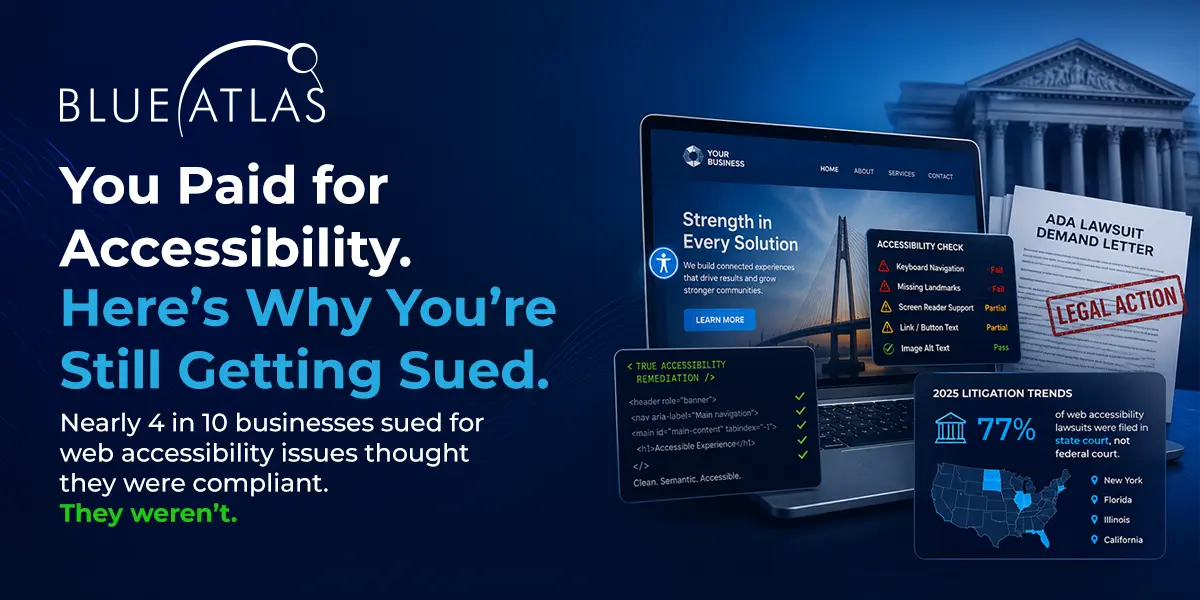
A Pennsylvania court just ruled that an inaccessible website violates the ADA on its own. With e-commerce absorbing nearly 70% of all federal web-accessibility lawsuits in 2025, retailers who relied on a physical-store argument to avoid liability are running out of runway.
For years, retailers with brick-and-mortar locations leaned on a common piece of conventional wisdom: if customers could walk into one of your stores, any problems with your website were a secondary concern at best. Courts had been inconsistent enough on the question that the argument held water in some jurisdictions.
That logic is getting harder to sustain. In 2025, federal courts saw 3,117 web-accessibility lawsuits — a 27% jump over the prior year — and roughly 70% of those suits targeted e-commerce specifically. A Pennsylvania court’s ruling in Wilkins v. Smashburger added a sharper edge to the data: the court held that an inaccessible website violates the Americans with Disabilities Act on its own, regardless of whether the company also operates physical locations.
For retail and restaurant brands, the message from the data and the courts is the same: the website is the exposure, and a physical footprint is not an offset.
The Numbers Are Not Hypothetical
The most common response Nate Stockard hears when he presents litigation data to retail clients is a version of calm skepticism. They accept the numbers. They just don’t believe the numbers will find them.
“There’s not a disbelief in the numbers, but there is a disbelief that they’re going to be affected by it.” — Nate Stockard, Blue Atlas Marketing
The UsableNet data gives them reason to reconsider: a web accessibility lawsuit for e-commerce retailers is no longer hypothetical. Of the top 500 online retailers, 35.8% have already been sued at least once. That is not a projective figure — it is a historical one. One in three significant online retailers has already sat across from a plaintiff’s attorney
The federal count is only part of the picture. When state court filings are included, the total number of web-accessibility suits in 2025 was well over 5,000 — and some estimates, accounting for all accessibility-related complaints, put the number closer to 26,000.
Stockard frames the position plainly: “A third of you have already been sued. The other two thirds — they’re just waiting to find you.”
Why the Physical Store Argument Fails
The “we have stores” defense rested on a reading of the ADA that required some nexus between a website and a physical place of public accommodation. If a retailer had locations customers could visit in person, the argument went, a broken website was an inconvenience, not a civil rights violation.
Wilkins v. Smashburger did not accept that framing. The Pennsylvania court ruled that the website itself was a place of public accommodation — that the inaccessibility of the site was the violation, independent of what was available in a store.
Stockard notes that the more important shift may be practical rather than legal. The web was always the primary entry point; courts are now treating it accordingly.
“People are not walking into your brick and mortar first. They’re going to your website first. The website is the front door.” — Nate Stockard, Blue Atlas Marketing
He adds a dimension that courts are increasingly receptive to: automated testing can scan thousands of websites in a day. A serial plaintiff cannot visit thousands of physical locations in a day. The exposure is asymmetric, and it has always been so — the litigation volume just makes it visible.
The geographic spread in the UsableNet data reinforces that this is no longer a regional story. Litigation historically concentrated in New York, Florida, and California has moved into Pennsylvania, Minnesota, Missouri, and Illinois. In 2025, one law firm and one plaintiff account for 16% of Illinois’s state-level accessibility filings — a sign of systematic targeting, not random litigation activity. Illinois also carries additional statutory penalties on top of any judicial award, which makes it a structurally attractive jurisdiction for plaintiffs’ firms.
What Actually Gets E-Commerce Sites Sued
Accessibility failures that generate lawsuits are rarely about aesthetics. They are structural, and they tend to cluster in predictable places on retail sites.
Stockard describes the fastest diagnostic he uses in an audit: stop using the mouse and start pressing Tab.
“If you’re going from title to title to title to title, and then picture, picture, picture — the screen reader and the user relying on one cannot put all the pieces together for one product. You’re asking them to remember everything they just saw across four or six products.”
The structural failures he sees most consistently on e-commerce sites include:
- Broken tab order on product grids — screen reader users encounter product names and images in a sequence that does not correspond to individual products, making it impossible to evaluate and select items.
- Unlabeled form fields at checkout — form inputs without programmatically associated labels mean users relying on screen readers cannot determine what information is being requested.
- Keyboard traps — points in the interface where keyboard navigation enters a component but cannot exit without a mouse.
- Missing or poor image alt text — particularly on product photography, where the image is often the primary carrier of product information.
These failures share a common characteristic: automated scanners miss most of them. Independent tool comparisons find that even the best scanners — axe, WAVE, Lighthouse — catch somewhere between 30% and 57% of WCAG issues. The failures that generate lawsuits tend to live in the other half.
The development and design gap compounds the problem. Most web developers, Stockard says, have limited training in accessibility requirements, and the WCAG technical criteria are written at a graduate reading level. Designers and developers who do not regularly collaborate on accessibility often produce interfaces that look clean but fail structurally.
Revenue Is a Signal to Plaintiff’s Firms, Not to Courts
UsableNet’s data shows defendants with $25 million or more in revenue representing a growing share of filed cases. The explanation, Stockard argues, is simpler than it might appear.
“Revenue is just an indicator for the plaintiff’s firm. It’s not your technical website that’s the indicator — it’s the check they think they can get.”
Larger retailers often have simpler checkout flows, not more complicated ones, because they have learned that friction in checkout costs revenue. The website is not necessarily more broken at $25 million than at $5 million. It is simply more worth pursuing.
The practical implication is that the threshold for becoming a target is lower than most mid-market retailers assume. A brand doing $25 million in online revenue with a clean, modern site that has never received an accessibility complaint is not in a safe position. It is in an unaudited one.
“You’re going to pay one way or the other. It’s are you going to wait until you get sued and be at the court’s mercy — or do it on your own terms?” — Nate Stockard, Blue Atlas Marketing
What a Realistic Path to Compliance Looks Like
When a mid-market retailer says they have never received a complaint and assumes that means they are fine, Stockard typically opens with a question rather than a correction: “Do you realize that about 25% of the population uses assistive technology and may not be able to use your website?”
The absence of complaints is not evidence of accessibility. It is evidence that users who encounter barriers often abandon the site rather than report it. A serial plaintiff’s attorney, running automated discovery tools across thousands of sites, is not waiting for a complaint before filing.
He also points out that a demand letter addressed to a website often opens a broader investigation into physical locations. Attorneys who identify web failures sometimes commission in-person inspections of stores shortly after. The scope of exposure tends to expand once litigation begins.
The Department of Justice has signaled in recent enforcement settlements that writing a check is no longer sufficient. Consent decrees increasingly require ongoing auditing, monitoring, and documented remediation processes. Doing that work proactively, on a retailer’s own schedule, is materially different from doing it under a court’s timeline.
The W3C Web Accessibility Initiative’s forms tutorial documents the technical baseline for checkout and contact forms — every input needs a programmatically associated label, placeholders are not labels, and errors must be communicated in text rather than color alone. These are not aspirational standards. They are the criteria against which sites are evaluated when complaints are filed.
Find Out Where Your Site Actually Stands
A human-led ADA audit identifies the structural failures automated tools miss — the same failures showing up in litigation.