Most ADA Lawsuits Don’t Start With a Person. They Start With a Bot.

Want to hear an audio version of this article? Click the play button below.
New research on how plaintiff firms actually target defendants in 2026 changes the math on website accessibility.
For two decades, the picture most organizations have carried in their head of an ADA website lawsuit has been roughly the same. A user with a disability lands on the site. They get frustrated. They tell a lawyer. The lawyer calls.
That picture is wrong.
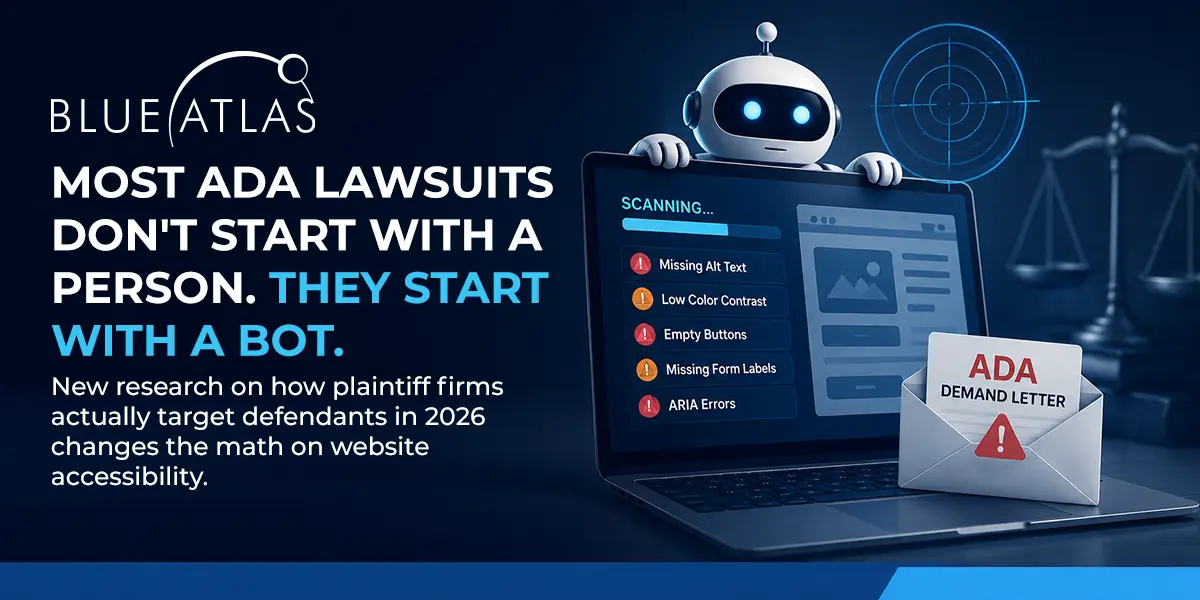
Plaintiff firms now scan hundreds of sites at a time looking for obvious WCAG failures. The scanner flags the issues. The demand letter goes out within days. By the time a human is involved on the plaintiff side, the case is already built.
That changes what “being at risk” actually means. And it changes the math on what a website accessibility audit is worth.
How the Trigger Actually Works
The pipeline TestParty describes is industrialized. A handful of high-volume plaintiff firms operate the same workflow over and over again.
Step one is the scan. Free tools and commercial scanners run against batches of websites, looking for the kinds of WCAG failures that show up in automated output: missing alt text, empty buttons, empty link destinations, low color contrast. These are findings a machine can produce in seconds.
Step two is documentation. The firm captures the scan results, often across several visits over a few weeks, to show the issues are persistent.
Step three is the demand letter. It cites the failures, threatens federal Title III litigation if not resolved, and quotes a settlement number.
“The mailer shows up pretty quick,” said Nate Stockard, President at Blue Atlas Marketing. “The people who are firing these off based on an automated scan are just in it for the money. They’re firing off as fast as they can get it, and they’re firing off as many as they can get to see who actually sticks.”
What the Bot Actually Finds
The failures that trigger demand letters are not subtle. They are the failures present on the majority of home pages on the web, easy to detect, and well-documented in the WebAIM Million’s annual scan of the top one million sites.
The categories scanners hit first are:
- Color contrast errors, because contrast is in the CSS and a machine can compute it
- Missing or empty alt text on images
- Empty buttons and links with no accessible name
- ARIA labels that are missing, broken, or misapplied
- Form inputs with no programmatic label
Automated scanning catches about 30 to 40 percent of WCAG issues. Everything else requires a human reviewer. The point is not that the bot finds everything. The point is that the bot finds enough.
“Alt text might exist, but image123.jpg is not useful alt text,” Nate Stockard said. “It would not help somebody using a screen reader to read your site. A human would say that doesn’t work.”
Why “We’re Too Small” Doesn’t Work Anymore
The most common objection from prospects is some version of “nobody is going to come after us.” TestParty’s data, plus the broader litigation picture, says otherwise.
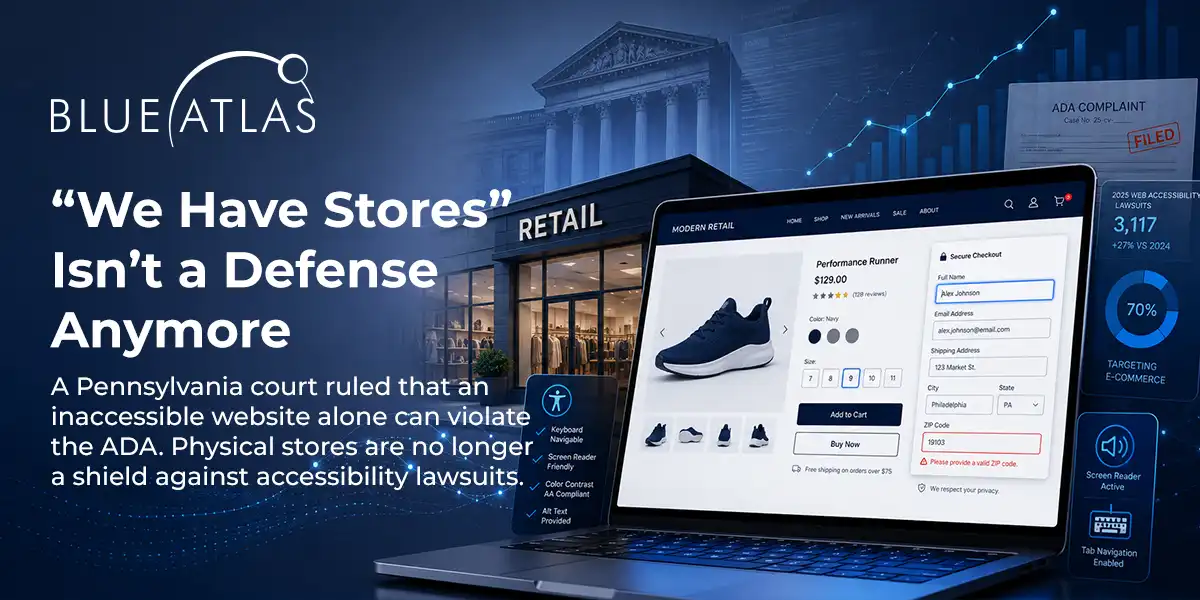
The volume backdrop, per Seyfarth Shaw’s 2025 federal court count, is 3,117 federal web accessibility filings in 2025 alone. That figure does not include state court filings, which now make up the majority of cases. The targeting logic actually favors smaller organizations, not larger ones.
“Plaintiffs filing lawsuits for the sake of money don’t know how big you actually are,”Nate Stockard said. “A smaller company is going to be the one to say, you know what, let me just settle so I don’t have to go through a big lawsuit. Big companies have lawyers on staff. Smaller companies don’t. They get an official-looking demand letter, they scan the site, they realize it’s broken, and they write the check.”
The size of the check is the point. A plaintiff firm is happy to take a $15,000 to $20,000 settlement from a small business that would otherwise spend $50,000 to $100,000 fighting the case. Small targets are not safer. They are easier to monetize.
Repeat defendants are the second pattern. TestParty reports that more than 40 percent of 2024 cases were filed against organizations that had been sued before. The reason is straightforward.
“People are just writing checks but not fixing it,” Stockard said. “If you got sued and you lost the first time and you haven’t fixed it, you’ll get sued and lose a second time.”
The Math Plaintiff Firms Run Before They File
The plaintiff-side economics are visible in the cost tiers themselves. According to a 2026 analysis by the Law Offices of Nolan Klein, settlement costs scale predictably with how far a case progresses: $1,000 to $25,000 at the demand letter stage, $25,000 average for out-of-court resolution (up to $100,000), $75,000 and up at court judgment, and $6 million or more at class action.
A defense attorney’s read confirms the targeting math. In a May UsableNet interview with John Magliery of Davis Wright Tremaine, the partner explained that plaintiff firms calculate the defendant’s likely settlement number against their own defense cost before sending the letter. A case moves forward only when the settlement is cheaper than the fight.
That math falls apart when the defendant already has an audit and remediation plan in hand.
“With an audit and remediation plan, their calculations go out the window,” Stockard said. “You’re going to say, I have a plan, and I’ll defend it because I don’t need to spend that much money to defend it. We already started the process.”
Where an Audit Interrupts the Chain
Walk back through the pipeline, and a documented audit changes the math at two distinct points.
At the scanner stage, the audit prevents the scan from generating a target. If the obvious WCAG failures have been fixed in the underlying code, a scanner produces a clean result, or a result thin enough that the firm moves on to easier prey.
At the demand letter stage, the audit changes the defense posture. A prospect who has been audited, started remediation, and documented the work can respond to a demand letter with a plan, a timeline, and a paper trail.
“If we’re in process the moment a demand letter arrives, we have a complete response,” Nate Stockard said. “I’m glad you came across this. We’re already aware of it. We’re in process. Here’s our timeline. Any decent attorney is going to look at that, decide it’s going to be a challenge, and move on to the next one.”
The overlay question deserves a separate line. According to TestParty, more than 1,000 businesses with overlay tools installed were still sued in 2023 and 2024. The FTC’s January 2025 $1 million order against AccessiBe made the deceptive nature of those compliance claims a matter of federal record.
“An overlay is a huge red flag for getting sued,” Stockard said. “Serial plaintiffs are going to sue everybody who has an overlay. You’re not getting peace of mind. You’re getting peace of, I’m probably going to get sued.”
The Cost Calculation
The headline economics are not close. TestParty’s analysis puts proactive remediation for most organizations at $5,000 to $30,000. A single lawsuit runs $55,000 to $270,000, and that range tracks with what Blue Atlas sees on real payouts in higher education, where average exposure runs between $75,000 and $250,000. The AudioEye 2026 Web Accessibility Litigation Report puts the share of sued organizations that had an overlay installed at nearly 40 percent, confirming that the cheap option is also the recurring one.
“It’s like saying, I’m going to buy a new car and pay cash so I don’t have to have insurance. I’m just going to ride around and see if I get hit, and then I’ll talk about buying insurance,” Nate Stockard said. “It doesn’t make any sense.”
Reputation is the other half of the cost. A lawsuit becomes a public record. It surfaces in search results next to the organization’s name for years. Prospects, donors, parents, voters, and future hires can all see it.
“As soon as somebody starts Googling your name, they’re going to find the lawsuit or an article saying you don’t care about disabled people,” Stockard said. “That’s a tarnished reputation, unnecessarily.”
The Misconception Worth Correcting
Of every argument an organization makes for waiting, the one that fails first is the one about size.
“The biggest misconception is, we’re too small to be sued, we’re too small to be seen, no one’s coming after this,” Nate Stockard said. “Fashion Nova was a $5 million class action. That’s not Amazon. That’s not Dell. It’s a brand most people don’t recognize. Small organizations get sued constantly, often because they’re more likely to write the check just to make it go away.”
The scanner does not check the organization’s revenue. It checks the code. The plaintiff firm does not investigate the cap table. It runs the settlement math. Both of those steps happen before any human at the defendant has heard about the case at all.
The defensible position is the one that breaks the pipeline at step one.
Where Does Your Website Stand?
A Blue Atlas audit runs the same checks a plaintiff firm’s scanner runs, plus the manual WCAG review the scanner cannot do. Our audits map findings to WCAG 2.1 Level AA, identify the issues that trigger demand letters, and produce a remediation plan that doubles as a defense if a letter ever arrives.