Nearly Half of ADA Website Lawsuits in 2025 Hit Companies That Had Already Been Sued


Want to hear an audio version of this article? Click the play button below.
A 27% surge in federal web accessibility filings last year is only part of the story. The repeat-defendant data exposes a costly cycle and what it actually takes to break it.
When the Department of Justice extended its ADA Title II web accessibility deadline in April 2026, just four days before it was set to take effect, a lot of organizations exhaled. The phone calls slowed. Budget conversations got pushed to next quarter. The sense of urgency that had been building for months quietly evaporated.
That reaction is exactly what the lawsuit data predicts.
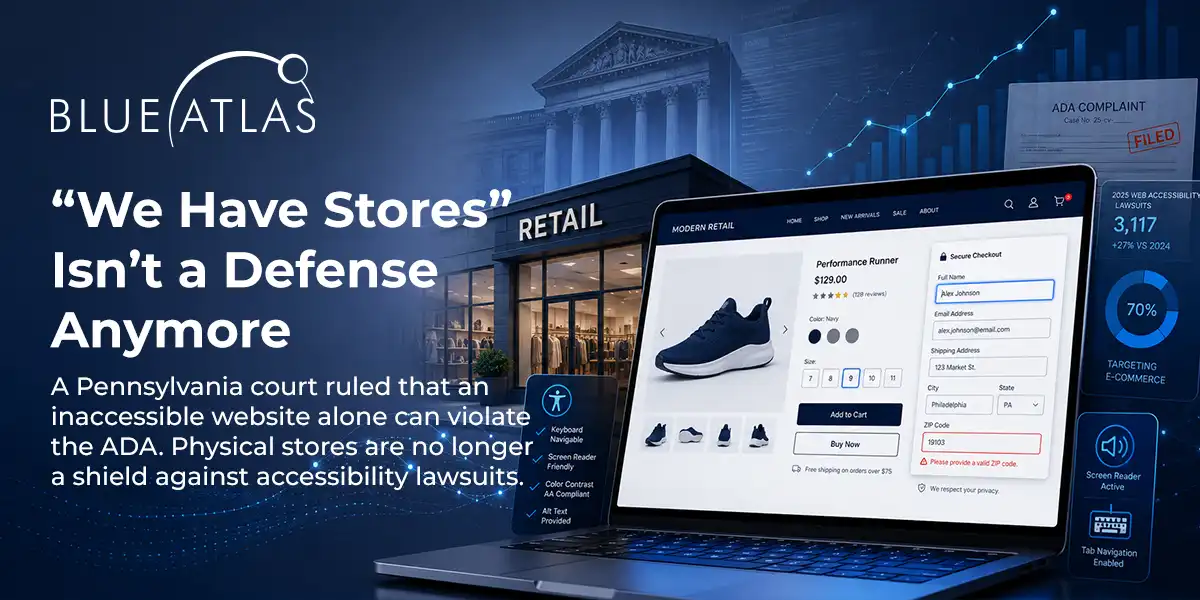
According to Seyfarth Shaw’s annual ADA Title III litigation report, federal courts saw 3,117 website accessibility cases filed in 2025; a 27% jump over the prior year. Website cases now represent 36% of all ADA Title III federal filings. And the plaintiff bar isn’t slowing down: pro se filings, meaning individuals suing without an attorney, jumped 40%, largely because AI tools have made it easier than ever to identify a noncompliant site and file a complaint.
But the most striking number in the data isn’t the total count. It’s this: according to UsableNet’s 2026 annual report, 46% of federal ADA web cases in 2025 targeted defendants who had already been sued before.
Nearly half of the companies facing a lawsuit last year had already been through one. They thought they’d handled it. They hadn’t.
Why the Numbers Don’t Scare People; Until They Should
“A lot of people don’t flinch,” said Nate Stockard, founder of Blue Atlas Marketing. “When you say 3,000 cases across the country and we have 350 million people, it sounds like a small number. They’re not looking at the fact that not doing this could mean a $150,000 to $200,000 lawsuit.”
That’s the gap in perception: organizations frame risk by case volume, not by exposure per incident. For a small city, a community college, or a regional business, a $200,000 settlement isn’t an abstract statistic; it’s a budget crisis.
The problem compounds when organizations believe they’ve already addressed it. Stockard described a recent prospect who had contracted with an automated scanning vendor and was told their score of 76% exceeded the “required” threshold of 67%. “That number was basically made up,” he said. “That’s not going to hold up in court.”
2025 Federal ADA Website Accessibility Lawsuits: By the Numbers
3,117 federal cases filed, up 27% from 2024 (Seyfarth Shaw)
46% of federal cases targeted repeat defendants (UsableNet)
5,000+ total digital accessibility lawsuits across all venues
Pro se (no-attorney) filings up 40%, driven by AI-assisted complaint tools
Florida nearly doubled its filings: 470 in 2024 to 961 in 2025
The Repeat-Defendant Trap: Why One Settlement Isn’t Enough
Getting sued, settling, and moving on sounds like resolution. In practice, it’s often the beginning of a second exposure. The pattern Stockard sees again and again: a business gets hit, panics, and reaches for the fastest and cheapest option available.
“They go find a cheap solution; a web developer who tells them they just have to do these things and you’re done,” he said. “Or they arrive at the overlay companies. Somebody gives you a little script, and now there’s a little blue icon in the corner that says you’re compliant. They’re not. That’s why they’re getting sued again.”
The core problem is that WCAG compliance, the technical standard at the heart of ADA web requirements, is a code-level obligation. It requires that every page layout be tested against dozens of criteria using actual assistive technologies: screen readers, keyboard-only navigation, magnification tools. Automated scans, at best, catch a fraction of the issues.
“Just because you run a scan doesn’t mean everything is actually compliant,” Stockard said. “A lot of developers have no idea what [WCAG compliance] even means. So they either don’t know what they’re doing, they charge too much because they’re throwing out a number, or they charge for the time because it is genuinely complex.”
For organizations that have already been sued once, the stakes on the second round are higher. “If you were sued the first time and you get sued again, they’re going to say: you knew this was a problem. Why didn’t you take care of it properly? At that point, the court is much more likely to settle in favor of the plaintiff.”
Overlays: Why the “We Already Have a Widget” Answer Doesn’t Hold Up
The overlay conversation comes up constantly in accessibility sales and compliance discussions. A business installs a $100/month script, a small icon appears in the corner of the website, and the team moves on believing the legal exposure is closed.
The data says otherwise.
More than 800 businesses using overlay solutions were still sued in 2023–2024, according to industry tracking data. The FTC finalized a $1 million consent order against accessiBe in April 2025, permanently barring the company from claiming its AI widget can make any website WCAG-compliant. More than 600 accessibility professionals have signed a public statement declaring overlays do not meet legal requirements.
And in the LightHouse v. ADP settlement, overlays were explicitly rejected as an adequate remediation strategy.
Stockard puts it plainly: “You’re being lied to, and you’re believing that lie and not doing what you actually need to do. An overlay does not change the underlying code. It cannot rearrange your content or reprogram it. It paints over the problem. And every plaintiff’s expert knows how to spot that paint in about 30 seconds.”
Compounding the issue: the DOJ’s own rationale for the Title II deadline extension cited “limitations of generative AI for content remediation.” In plain terms, the federal government acknowledged that automated tools, including AI-based solutions, cannot reliably achieve WCAG compliance on their own.
The DOJ Extension Didn’t Move the Legal Risk
When the DOJ announced its extension, Stockard watched the same dynamic play out in real time. “I was talking to people right before the deadline and they were worried,” he said. “As soon as the extension was announced, everybody said, okay, great, let’s talk next week. And next week is going to become next month, and then people are going to put it off.”
The legal reality hasn’t changed: the DOJ extension affects only the agency’s own enforcement timeline. It does not suspend Title II’s underlying nondiscrimination obligations. Private plaintiffs, individuals and advocacy organizations, can still file suit today, and they are. The 3,117 lawsuits filed in 2025 operated entirely through the private right of action.
For private-sector businesses under Title III, there is no extension of any kind. The Ogletree Deakins legal analysis notes that the extension may actually redirect litigation attention back toward commercial websites, as plaintiff attorneys shift focus during the public-entity grace period.
“You should be just as worried today as you were last year, as you were right before the April deadline, as you were two years ago,” Stockard said. “This is not a don’t-worry-about-it-until-next-year situation. The Department of Justice is not going to sue you, but you still need to take action now.”
The AI-powered pro se filing trend adds another layer of urgency. “People are using ChatGPT or Claude or Perplexity to go out and find a site and say: run an audit and tell me if they’re not compliant,” Stockard said. “And there’s nothing stopping that person from filing a suit once they have that answer.” His projection: 2026 lawsuit filings will exceed 2025 by at least 20%, possibly more.
What a Real Remediation Process Actually Looks Like
For organizations asking what to do right now, Stockard’s advice is consistent: start with a manual human audit. Not an automated scan. Not an overlay. A human audit.
The distinction matters for two reasons. First, automated scans miss the majority of WCAG failures. Only manual testing with actual assistive technology tools catches the full scope of what needs to be fixed. Second, having an audit in progress is itself a legal posture.
“If you’ve already started (if you have a plan and you’re in the process) and you do get hit with a lawsuit, you can respond to say: we understand, we know this, we’re already working on it. That response letter changes the conversation significantly,” Stockard said.
How a Human Audit Works
Blue Atlas’s audit process covers all primary page layouts on a site; not every individual page, but every distinct template type. Each layout is tested against every WCAG 2.1 AA success criterion using actual assistive technology:
- Screen reader testing with the monitor off or screen turned away
- Keyboard-only navigation with the mouse physically unplugged
- Contrast, focus indicator, and color-independence checks
- Form, table, and multimedia accessibility review
The output is a detailed findings report that identifies each issue, its location on the site, and developer notes on how to fix it. Organizations can take that report to their own development team, a third-party developer, or return to Blue Atlas for remediation.
“What you walk away with is exactly what needs to be fixed, exactly where it is, and some direction on what it takes to fix it,” Stockard said. For organizations that proceed with Blue Atlas for remediation, the cost of the audit is applied toward remediation, effectively making the audit free.
The Bottom Line: Use the Time, Don’t Waste It
The DOJ’s extension created a window. Whether organizations use it for genuine remediation or for procrastination will determine whether 2027 looks like 2024, or worse.
The repeat-defendant data is the clearest signal in the 2025 numbers: surface-level fixes fail. Overlays fail. Automated scans fail. One-time patch jobs fail. What works is a thorough audit, code-level remediation, and ongoing monitoring. Websites change constantly, and every new page is a new opportunity for a new violation.
For organizations that haven’t started, the cost of waiting is higher than the cost of starting now. And for those who have already been sued once, the message from the data is unambiguous: the second lawsuit carries far more weight than the first.
Get a Professional ADA Website Audit
Blue Atlas Marketing offers manual human ADA website audits with actionable developer notes, full WCAG 2.1 AA coverage, and the option to apply your audit investment toward full remediation. Don’t wait for the lawsuit; know where you stand.
→ Request your ADA Website Audit
Sources
Seyfarth Shaw, ADA Title III Blog — “Federal Court Website Accessibility Lawsuit Filings Bounce Back in 2025,” March 2026
UsableNet — “ADA Web Lawsuit Trends for 2026: What 2025 Filings Reveal,” January 2026
Federal Trade Commission — “FTC Approves Final Order Requiring accessiBe to Pay $1 Million,” April 2025
Ogletree Deakins — “DOJ’s Extension of Government Website Accessibility Guidelines May Impact Private Sector Websites,” April 2026
Federal Register (DOJ) — “Extension of Compliance Dates for Nondiscrimination on the Basis of Disability,” April 20, 2026
Adirondack Website Design / 216Digital — “Lawsuits Rise Against Companies Using Overlay Solutions,” 2026
Nate Stockard, Blue Atlas Marketing — interview transcript, April 30, 2026