How to Generate Leads at Events and Turn Chats into Sales


Think trade shows don’t work for lead gen? Think again. The problem isn’t the event—it’s the strategy. When used right, event marketing is a great way to boost your marketing efforts and connect with potential customers face-to-face.
In this guide, you’ll learn how to generate leads at events using proven tactics for event lead generation. From planning to follow-up, we’ll break down what effective lead generation really looks like.
Whether you’re tired of awkward pitches or low ROI, these marketing strategies will help you turn every event into a pipeline-building opportunity.
Key Takeaways:
What “Lead Generation” Really Means at Events (and Why It’s Worth Your Budget)

Before you can fix your event lead strategy, you need to understand what you’re actually aiming for.
Spoiler: It’s not just collecting business cards in a fishbowl.
The Definition of Lead Generation at Events
Lead generation at events is all about starting relationships with the right people.
These events are built to attract prospects who are already curious or in need of what you offer.
Whether it’s a trade show, seminar, networking mixer, or hosted buyer event, the goal is always the same: get people interested, capture their info, and move them closer to a buying decision.
These aren’t just networking opportunities…they’re tactical.
The most successful events are structured around engagement: the kind that gathers contact details, builds trust on the spot, and opens the door for follow-up conversations.
Think of it as marketing with a handshake.
Why It Actually Matters?
Here’s the thing: events don’t just bring foot traffic. They bring intent. People don’t show up at an industry expo for the free pens (okay, maybe some do).
But most are there because they’re actively exploring solutions. They want to see what’s out there. That’s your cue.
When done right, event-based lead generation fills your sales pipeline with warm contacts, not cold ones.
It’s faster, more personal, and often more cost-effective than digital ads or cold outreach.
If you’re ignoring event strategy, you’re leaving real leads on the table.
Get Your Tools (and Targets) Straight Before the Event Starts
You don’t need every tool on the market. But the right mix can help you collect leads faster, qualify them better, and follow up smarter.
Here’s a snapshot of some standout tools worth having in your kit:
| Tool | Main Use | Why it Matters | Pricing |
|---|---|---|---|
| OptinMonster | On-site popups & lead capture | Great for grabbing attention on landing pages or post-event microsites | Basic – $84/yearPlus – $228/yearPro – $348/yearGrowth – $588/year |
| Zapier | Workflow automation | Connects apps like your CRM, email, and calendar tools with zero coding | FreeProfessional – $19.99/monthTeam – $69/monthEnterprise – Contact for Pricing |
| Salesforce Cloud | CRM + email marketing | All-in-one lead management—track, score, and nurture leads in one place | Prices vary depending on the service. |
| Pipedrive | CRM + pipeline management | Visualizes your sales funnel and makes follow-ups easier | Essential – $14/monthAdvanced – $24/monthProfessional – $49/monthPower – $59/monthEnterprise – $49/month |
| Dealfront | B2B data & targeting | Helps you find companies that match your ideal customer profile | Custom Quote |
| Calendly | Meeting scheduling | Removes back-and-forth and makes it easy for leads to book time with you | FreeStandard – $10/monthTeams – $16/monthEnterprise – $15,000/year |
| LeadPages | Landing page builder | Simple drag-and-drop builder for event-specific lead capture pages | Standard – $37/monthPro – $74/monthCustom Pricing |
| Unbounce | A/B testing for pages | Optimize landing pages for better conversion rates | Build – $74/monthExperiment – $112/monthOptimize – $187/monthAgency – Custom Pricing |
| ClickFunnels | Funnel builder | Streamlines lead-to-sale path with pre-built sequences | Startup – $81/monthPro – $248/month |
| Snov.io | Email outreach & lead tracking | Good for lead gen teams running email follow-ups post-event | Trial – $0/monthStarter – $30/monthPro – $75/month |
Setting goals isn’t just something you toss on a pre-event checklist. It should guide which tools you actually use.
If your goal is 200 qualified leads and your team usually converts 10%, you know what kind of foot traffic and lead quality you need to aim for.
Tools like CRMs and funnel builders help measure progress in real time, while automation software helps your team stay focused on conversations, not data entry.
Let’s Get Tactical: Your Event Lead Plan Starts Here
Guesswork doesn’t belong in your event strategy. This step-by-step breakdown keeps your lead generation efforts sharp and focused–starting with the people who matter most.
I. Know Who You’re Talking To (Seriously)
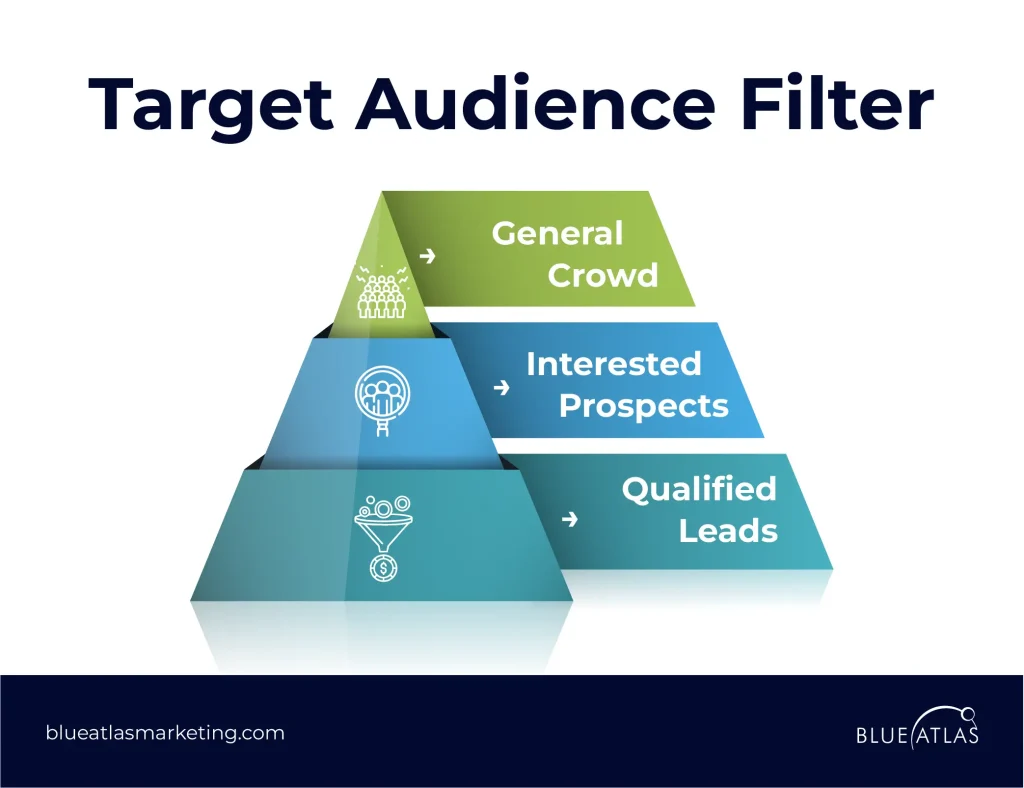
You can have the best booth, the slickest demo, and the flashiest swag but none of it matters if you’re speaking to the wrong crowd.
Think of your message like a language. If your audience “speaks” in ROI, and you’re pitching features, you’re not connecting. You’re confusing.
That disconnect happens more often than most marketers admit. It’s why so many booths are full of noise and not results.
Start with data. Use your CRM, survey past leads, review attendee lists from previous events.
Pinpoint who your best-fit customers are! It could be by role, industry, challenges, and buying behavior.
Next, build quick audience snapshots. Not a full marketing persona deck–just a sharp description of your ideal contact.
What do they care about? What keeps them from making a decision? What would actually make them stop at your booth?
Then align everything to them—your talking points, your signage, your offers.
Don’t waste time explaining technical specs if you’re trying to attract marketing leaders.
If you’re after engineers, ditch the buzzwords.
Dial in your audience, and every other step gets easier. Miss it, and everything feels like guesswork.
II. Picking the Kind of Event That Actually Works for You

Not every event is a good fit. And picking the wrong one can waste time, money, and your team’s energy.
Here’s how to choose smarter:
1. Match the Event to Your Business Goal
Are you trying to book meetings? Build awareness? Launch a product?
The type of event you choose should depend on the outcome you’re chasing. Big trade shows are great for visibility.
Executive dinners work better for relationship-building. Product launches thrive at branded events with controlled audiences.
2. Know the Event Formats
- In-Person: Best for hands-on demos, product sampling, and face-to-face selling.
- Virtual: Great for global reach, lower cost, and strong content delivery.
- Hybrid: Offers flexibility—mixing live and online elements to widen audience and extend engagement.
3. Ask the Right Pre-Event Questions
Before signing that booth contract, get clear on:
- Who usually attends?
- What are the industries and job roles?
- Are attendees there to buy, learn, or browse?
- Is lead data shared post-event?
- Can you sponsor or speak for added exposure?
4. Prioritize Quality Over Quantity
A smaller niche event filled with your exact audience beats a massive expo full of the wrong people. Always.
5. Consider the Extras
Can you host a side session? Sponsor a lounge? Add branded Wi-Fi or a demo room?
Little add-ons can boost visibility if aligned with your goals.
III. Build Content People Actually Want to Engage With
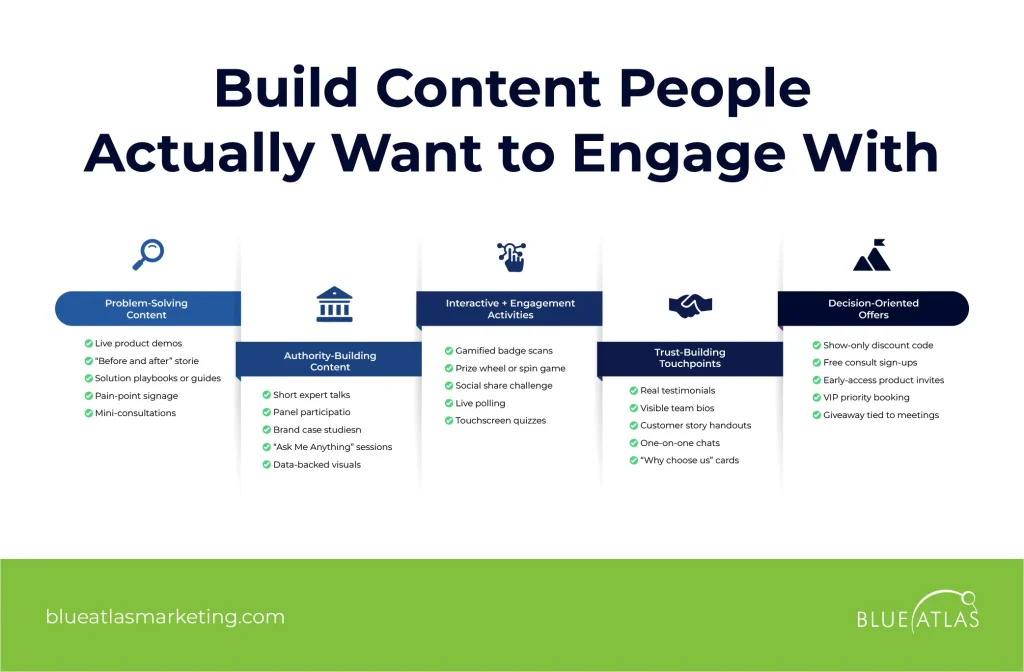
Booth visitors don’t owe you their attention and you’ve got to earn it with content and activities that pull them in and keep them talking.
Use this as a content filter when planning your booth, sessions, or promos:
Problem-Solving Content
- Live product demos – Show how your solution fixes a real issue in under 3 minutes.
- Before and after” stories – Highlight the problem, your solution, and the result.
- Solution playbooks or guides – Offer something useful they can scan, save, or share.
- Pain-point signage – Use phrases your audience actually says, like “Sick of tracking leads manually?”
- Mini-consultations – Give real-time advice on their specific use case.
Authority-Building Content
- Short expert talks – Share insights, not just sales pitches, right at your booth.
- Panel participation – Speak or moderate to boost visibility and credibility.
- Brand case studies – Feature well-known clients and the results they got.
- “Ask Me Anything” sessions – Let people ask your team about real problems.
- Data-backed visuals – Use stats and charts to reinforce your expertise.
Interactive + Engagement Activities
- Gamified badge scans – Turn lead capture into a fun mini challenge.
- Prize wheel or spin games – Simple, classic, and still pulls traffic.
- Social share challenge – “Post a photo at our booth, tag us, and win.”
- Live polling – Use tablets or QR codes to ask quick questions and show instant results.
- Touchscreen quizzes – Let visitors find the right product match in seconds.
Trust-Building Touchpoints
- Real testimonials – Use print or screens to show satisfied customer quotes.
- Visible team bios – Help visitors connect with the humans behind the brand.
- Customer story handouts – Quick reads that show what success looks like.
- One-on-one chats – Create a semi-private space for honest, useful conversations.
- “Why choose us” cards – Bullet-point benefits from a customer’s perspective.
Decision-Oriented Offers
- Show-only discount codes – Create urgency with offers they can’t get online.
- Free consult sign-ups – Make it easy to schedule post-event calls via QR or tablet.
- Early-access product invites – Let attendees opt into something exclusive.
- VIP priority booking – Offer limited spots for top-tier prospects to speak with sales.
- Giveaway tied to meetings – Book a demo, get entered to win something valuable.
IV. Use Tech to Capture the Right Data (Without Killing the Vibe)
The right tools don’t just collect contact info; they tell you who someone is, what they want, and when they’re ready to talk.
It’s not about gathering more data…it’s about gathering the right kind.
| Category | Definition | Specific Samples | When to Use |
|---|---|---|---|
| Contact Data | Basic personal details used to follow up post-event. | Name, email, phone number, job title, LinkedIn profile | Always—this is your starting point for any lead. |
| Firmographic Data | Info about the company behind the person. | Company name, industry, size, revenue, location | Use for B2B targeting and prioritizing high-fit accounts. |
| Intent Data | Behavior that suggests buying interest. | Booth visit frequency, content downloads, webinar attendance, time spent on product pages | Helps identify leads showing strong buying signals. |
| Trigger Event Data | Signals from company activity that may open a sales window. | Funding rounds, leadership changes, job postings, product launches | Use for timely outreach post-event when the lead is likely open to a solution. |
| Demographic Data | Personal characteristics and general identifiers. | Age, gender, region, department, seniority level | Useful for segmenting messaging and matching with the right rep. |
| Technographic Data | Tech tools or platforms the lead’s company already uses. | CRM provider, marketing automation platform, e-commerce stack, CMS, helpdesk tools | Use to customize your pitch based on what tools they already work with. |
V. Train Your Team to Capture Leads Without Sounding Like Sales Robots

A good booth design gets attention. A well-trained team turns that attention into leads.
Start by covering the basics. Your team should know what qualifies as a good lead, how to ask the right questions, and how to spot buying signals without being pushy.
This isn’t about pitching hard; it’s about listening well and knowing how to steer a casual conversation toward meaningful insight.
That’s the “core concepts” part—and most teams don’t spend enough time on it.
Next, make sure your staff knows how to use the tools. Whether it’s a badge scanner, CRM app, or a tablet form, tech fumbles look unprofessional and kill momentum.
Run through short demos and have team members practice with each other…this is where practice scenarios come in.
It’s not about memorizing scripts. It’s about getting comfortable and natural with the flow.
Then, build a feedback loop. After day one, gather the team and review what worked, what felt awkward, and what prospects responded to.
It’s a fast way to improve lead quality and fix issues before the next wave of attendees walks in.
For new or junior reps, pairing them with experienced team members through a casual mentorship setup can boost confidence fast.
And after the event, don’t let the learning stop–review the data, listen to follow-up calls, and use that intel to get sharper for the next event.
VI. Follow Up Like You Actually Want Their Business

The event might be over, but the lead generation isn’t. What you do after the booth closes matters just as much as what you did during the show.
Here’s a smart follow-up timeline to keep your brand top of mind without being pushy:
Within 24 Hours – Just Say Thanks
Send a simple thank-you email. Keep it light: “Great meeting you at [Event Name]!”
Include a photo of your booth or a link to a quick recap. No hard pitch, just a reminder that you’re a real person who paid attention.
2–3 Days After – Offer Something Useful
Now’s the time to follow up with a resource. This could be a product guide, a recorded session, or a checklist related to what you talked about.
Keep it relevant. Bonus points if it feels tailored.
1 Week Later – Start the Real Conversation
This is where you begin the actual sales dialogue. Ask if they’re open to a quick call or demo.
Reference your conversation so it feels personal, not automated.
2 Weeks Later – Share Social Proof
If they’ve gone quiet, send a case study or testimonial that matches their industry or problem.
No pressure. Just a nudge that says, “We’ve done this before, and it worked.”
1 Month Later – Last Touch (For Now)
Send a final check-in. Keep it short and friendly. Let them know the door’s open if the timing wasn’t right earlier. Then mark them for future nurture.
Make It Personal: Better Experiences = Better Leads
People don’t engage with brands, they engage with people who “get” them.
If your event presence feels tailored, they’ll stay longer, talk more, and become better leads.
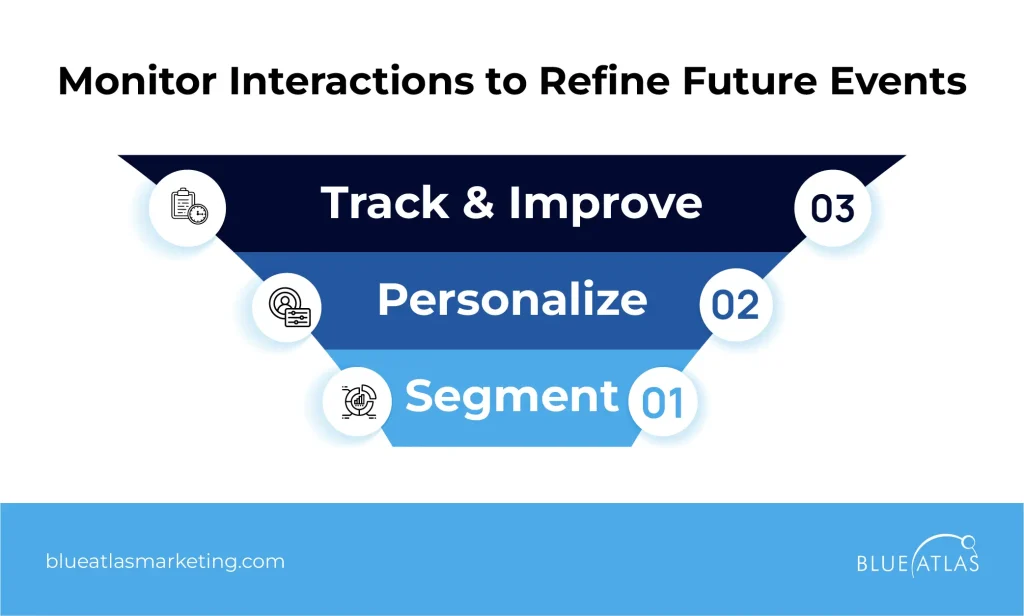
Create Segmented Customer Profiles
Start with segmentation. Before the event, use your CRM to group contacts by traits like industry, company size, title, purchase history, or past booth visits.
These segmented customer profiles help your team recognize who they’re talking to and what matters to that type of buyer.
For example, finance leaders may want to hear about compliance features, while marketing leads care about integrations and speed.
Prep your team with conversation starters based on each segment so they’re not flying blind.
Personalize Outreach with CRM-Driven Campaigns
Don’t send the same email to everyone post-event.
Use CRM data to run targeted campaigns–tailored by the attendee’s interest, booth behavior, or conversation notes.
Someone who asked about pricing should get your comparison sheet.
Or someone who downloaded a whitepaper last month might get a related case study.
The more specific your follow-up, the more likely they are to reply and remember you.
Bonus move: run live personalization during the event.
With tools like HubSpot or Salesforce, you can trigger real-time emails or text alerts when key leads scan in.
Monitor Interactions to Refine Future Events
Don’t let good data sit idle. Use your CRM to track booth behavior: who asked a question, who booked a meeting, who came back twice.
After the event, review these touchpoints with your team.
It’ll help you spot patterns, adjust your event strategy, and decide who to fast-track into the sales pipeline.
Frequently Asked Questions (FAQs)
What are the most cost-effective events for lead generation?
Smaller, niche industry events typically offer better ROI by attracting potential attendees who are genuinely interested, making your time and budget more effective compared to large expos with less targeted traffic.
How soon should I follow up after an event?
Follow up within 24 hours using personalized email campaigns that begin with a thank-you message. This keeps your brand top of mind without overwhelming leads or coming across as overly aggressive.
Can virtual events generate quality leads?
Yes—virtual events can work well when you include interactive elements, monitor attendee engagement closely, and use analytics to gather valuable insights that help identify and prioritize high-quality leads.
What tech should I bring to the booth?
Bring essentials like tablets, lead capture tools, CRM access, and a backup hotspot. These ensure smooth operations, efficient data collection, and real-time updates to support effective conversations with prospects.
How do I qualify leads on the spot?
Ask about needs, budget, and timeline in a natural way. Use data from event registration to personalize conversations, helping you quickly identify which leads are worth nurturing further.
Knowing how to generate leads at events starts with smarter event planning, not guesswork. By choosing events that fit your specific industry, training your team, and aligning every detail—from booth setup to content marketing—you attract the right leads.
When you follow through with intention, those conversations turn into potential leads and real business. Done right, your next event won’t just feel successful—it will drive measurable event success.
Ready to partner with Blue Atlas Marketing?
Let’s talk about how we can turn your event attendees into real opportunities.
Want help generating leads that actually convert? Contact us today and let’s build a results-driven event strategy together.