
Effective Digital Marketing for Tech Companies


Forget what you knew about tech marketing—2025 demands more. In today’s landscape, digital marketing for tech companies is no longer about just blogs and backlinks. With AI-generated content, saturated social media platforms, and a shift toward zero-click searches, the game has changed.
Your audience is sharper, and the pressure to align marketing campaigns with business goals and the sales process has never been greater. This isn’t a trend list—it’s your roadmap.
Explore digital marketing strategies built for real lead generation and lasting impact. If your pipeline depends on digital, it’s time to cut through the noise and get clear.
Key Takeaways:
The Backstory Behind Digital Marketing
Before you fix your strategy, you need to understand how the rules were rewritten.
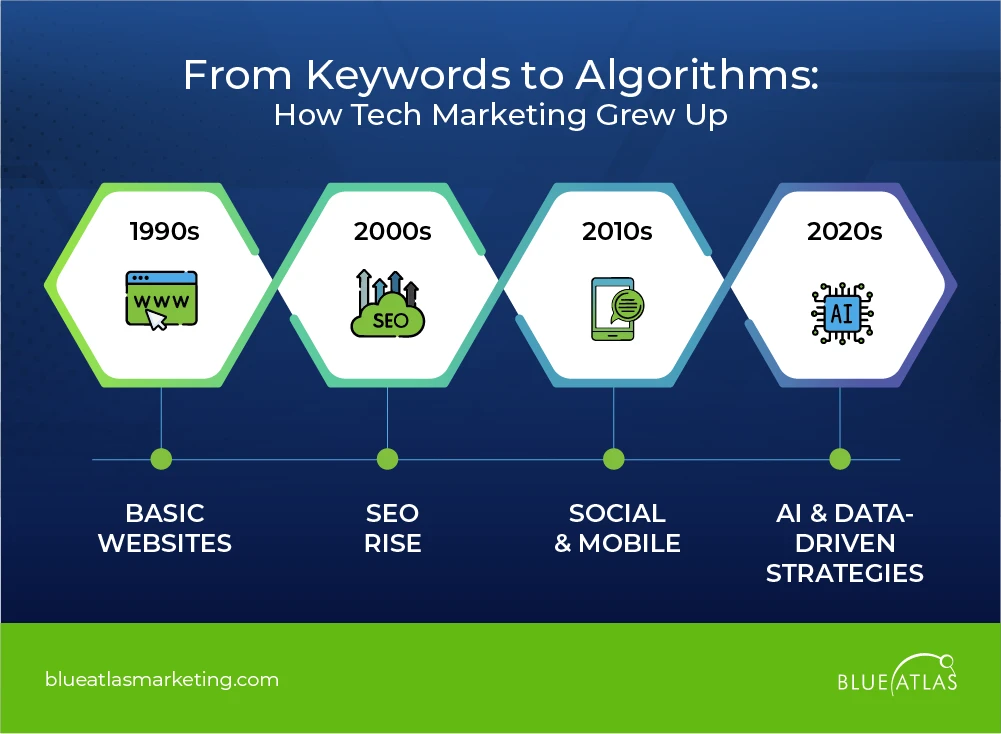
From Keywords to Algorithms: How Tech Marketing Grew Up
There was a time when “digital marketing” just meant having a website and maybe running a banner ad.
In the late ‘90s and early 2000s, it was all about getting found on search engines. Keywords ruled.
You could climb to the top of Google just by stuffing “cloud computing” onto your homepage twenty times.
Not anymore.
By the 2010s, things got more personal. Social media gave companies a direct line to their audience.
Mobile use exploded. Brands shifted from broadcasting to actually engaging–sort of.
You still needed spreadsheets to track everything. It was messy, but it moved the needle.
Then came the 2020s.
AI stepped in, and the guessing game was over. Algorithms could predict behavior, personalize content, and automate everything from segmentation to scheduling.
You stopped emailing your entire list and started targeting people based on behavior and buying intent.
Data became the difference between teams who were scaling and those who were stuck.
Digital marketing for tech companies isn’t just about running ads or writing content.
It’s a machine built on automation, fueled by analytics, and steered by smart strategy.
The evolution didn’t happen overnight. But if your approach still looks like it did five years ago, you’re already behind.
What Actually Matters: Core Tech Marketing Channels
You don’t need to do everything, you just need to know what each piece does (and when to use it).
| Core | What It Does | When It Works Best |
|---|---|---|
| SEO | Gets your content found via Google, Bing, etc. | Long-term lead gen and brand trust |
| Content Marketing | Educates, nurtures, and positions your product or team as the expert | Across the entire funnel, top to bottom |
| Social Media | Builds community, spreads awareness, and supports distribution | Ideal for early-funnel and brand engagement |
| Email Marketing | Re-engages leads and builds retention with direct communication | Mid to bottom funnel (nurturing + upsells) |
| PPC Advertising | Sends traffic fast and captures high-intent leads | Great for product launches or filling pipeline gaps quickly |
| Marketing Automation | Saves time with smart triggers and workflows | Works best with clean data and clear user journeys |
| Data + AI Integration | Analyzes behavior, predicts performance, and adjusts campaigns in real-time | Essential for large-scale or performance-obsessed teams |
| Video Marketing | Simplifies complex tech, humanizes your brand | Product demos, testimonials, or LinkedIn native content |
| Personalization | Tailors the experience to user actions, interest, or behavior | Improves conversion across email, web, and ads |
| User-Generated Content | Builds social proof and credibility | Amplifies trust in the decision phase |
Strategic Planning for Digital Marketing
Planning without watching the trends is like building a product no one asked for.
What’s Actually Trending (and Worth Your Attention)
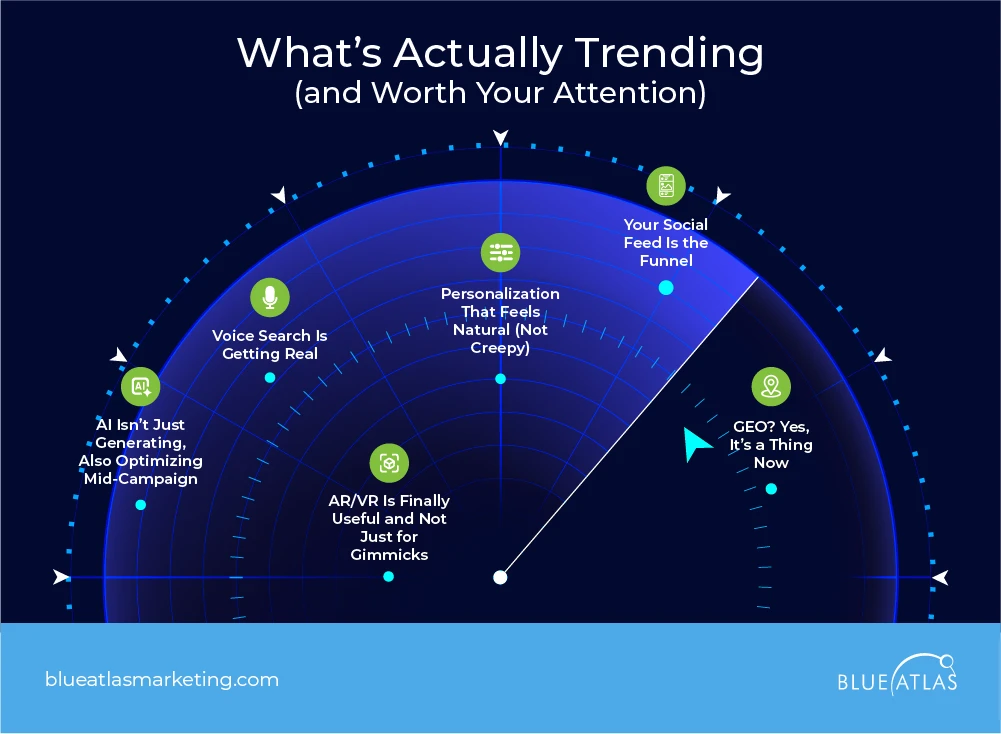
Here’s what’s shaping tech marketing this year—and what smart teams are already acting on:
AI Isn’t Just Generating, Also Optimizing Mid-Campaign
We’re past the point of “Hey, this tool writes blogs.” AI is adjusting ad creatives, rewriting CTAs on landing pages, and recommending budget shifts in real time.
Brands using tools like Mutiny and Jasper aren’t just speeding up workflows…they’re letting AI quietly A/B test content without human input.
If you’re still reviewing copy in Google Docs, you’re three steps behind.
Voice Search Is Getting Real
According to NPR and Edison Research, 35% of U.S. households now have a smart speaker.
That means millions of users are searching differently–longer phrases, natural language, and more commercial intent.
Think: “What’s the best B2B CRM with SOC 2 compliance?” If your SEO strategy isn’t accounting for conversational queries, you’re invisible to voice-first buyers.
AR/VR Is Finally Useful and Not Just for Gimmicks
Virtual tours, product demos, and interactive onboarding aren’t novelties anymore.
A dev-focused cybersecurity platform built a VR experience that walked users through breach scenarios in 3D.
Not only did it replace a static demo, but it also held attention longer and led to more demo requests. If your product takes more than 10 seconds to explain, show it in motion.
Personalization That Feels Natural (Not Creepy)
Dynamic content isn’t about adding first names to subject lines, but it’s about showing the right case study to the right persona at the right moment.
Think conditional CTAs based on scroll depth or banners that swap out by industry.
Smart personalization blends into the experience. If it feels obvious, it’s probably wrong.
Your Social Feed Is the Funnel
People scroll, scan, and act. Social commerce isn’t just for DTC brands.
Tech companies are using LinkedIn carousels with native CTAs, YouTube descriptions with one-click trial buttons, and Instagram Reels that feed directly into onboarding flows.
Fewer clicks. Less friction. More action.
GEO? Yes, It’s a Thing Now
Search engines are generating their own answers now using your content as fuel.
To show up in Google’s AI summaries, your pages need schema markup, clean structure, and content that answers questions head-on.
If your page reads like an essay and not a solution, it won’t be featured. Think of it this way: Google still shows results, but its AI chooses who speaks first.
Set Goals That Don’t Fall Apart by Next Quarter
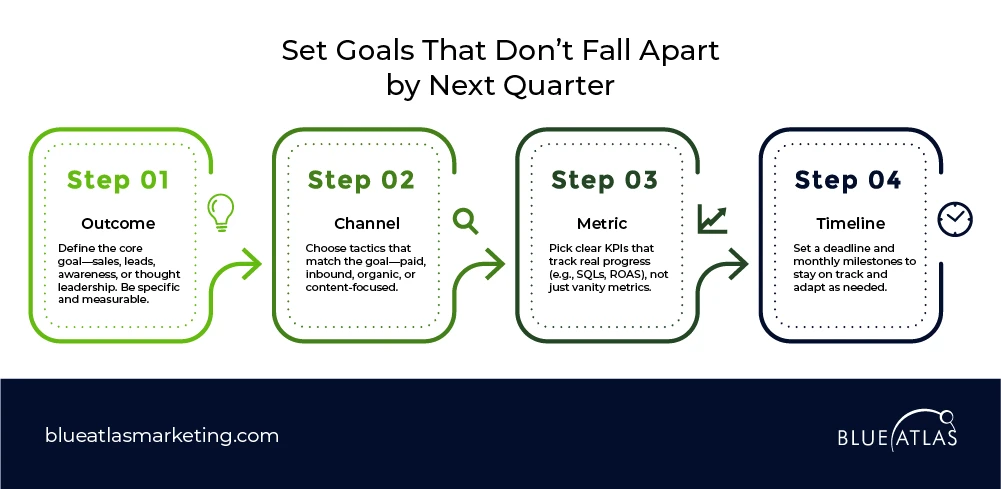
Marketing goals are easy to write and even easier to ignore. Here’s how to make yours actually work.
Step 1: Ask “What do we actually want?” – Start with this: Are we trying to increase sales, generate leads, grow awareness, or prove thought leadership?
This filters out all the noise and narrows your focus. For example, “get more visibility” becomes “increase organic traffic by 40% in Q2.”
The sharper the goal, the easier it is to build a plan that doesn’t fall apart in execution.
Step 2: Ask “What kind of marketing will get us there?” – Once the goal is clear, ask: Does this require inbound, paid, organic social, or content-driven campaigns?
Each type plays a different role. If the goal is to drive demos, you might prioritize BOFU content, paid LinkedIn, and retargeting.
A tech company focused on awareness might go heavy on TOFU videos and thought leadership without obsessing over form fills.
Step 3: Ask “How will we know if it’s working?” – Here’s the key: What metrics show progress, and which ones actually impact revenue?
Set primary KPIs (like SQLs or ROAS) and secondary indicators (like CTR or open rate).
If you’re aiming to strengthen inbound, don’t just track traffic…instead, focus on traffic quality and how it converts down the funnel.
Step 4: Ask “What’s a realistic timeframe?” – Now ask: When should we hit this, and what’s the checkpoint along the way?
Quarterly goals help guide strategy, but monthly milestones help keep things on track.
Give yourself room to experiment early, but tighten focus as the quarter goes on. Goals without timelines don’t get missed–they get forgotten.
When Your Tech Stack Actually Starts Pulling Its Weight
If your tech stack is just a bunch of disconnected tools, it’s not a strategy but a mess.
What AI Can Do (That You Can’t)
AI isn’t replacing marketers; it’s finally doing the parts they never had time for.
Instead of spending hours buried in dashboards, teams are using machine learning to scan data in real-time and surface what actually matters.
Tools like ChatGPT, Tableau with AI plug-ins, or Adobe Sensei aren’t just automating reports; they’re spotting patterns, flagging campaign fatigue, and predicting which audiences are most likely to convert.
This means marketers can stop reacting and start pre-planning based on real behavior.
It also raises the bar for experimentation. You don’t need to wait for quarterly reviews to know if a campaign is working.
AI can identify drop-off points in email funnels, underperforming ad variants, or CTA buttons that get ignored…and it does it while you’re sleeping.
This shift, from gut-feel to machine-informed, is what makes AI worth caring about.
Not because it sounds cool, but because it gives you back time, budget, and accuracy you didn’t have before.
How Big Data Stops You from Guessing
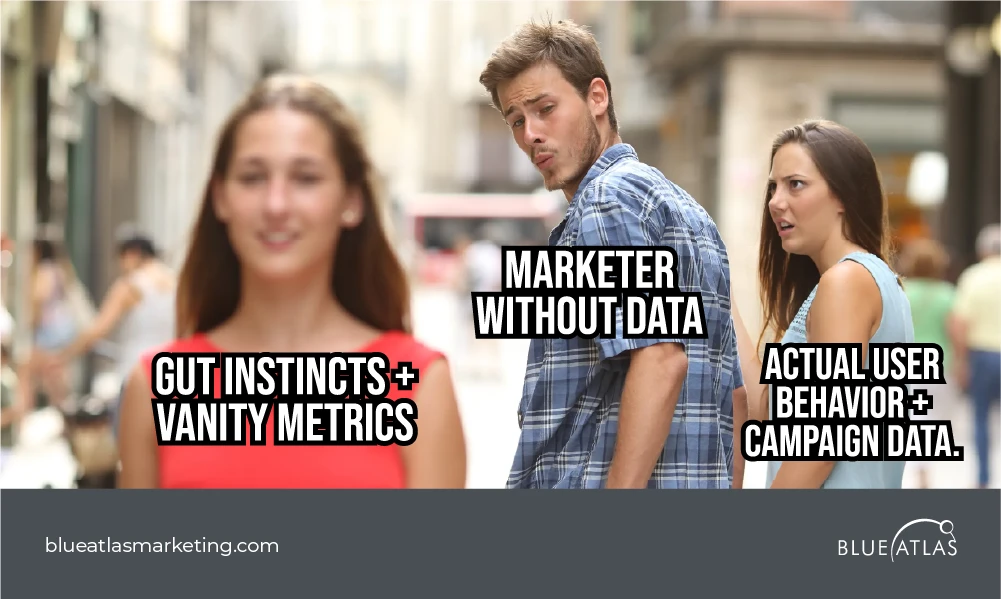
Big data is about finally using what you’ve already got. First, it helps with customer segmentation and targeting.
Instead of guessing who’s clicking, you know exactly which user groups convert and which ones bounce after five seconds.
That’s the kind of insight you can build a real strategy around.
Second, it improves behavior prediction. You’re not hoping a prospect will come back.
You’re seeing what similar users did, and preparing content or offers they’re likely to respond to.
That naturally feeds into real-time campaign optimization.
When a campaign starts to stall, you don’t need to wait until end-of-month reports to fix it–your data already told you what’s wrong.
Then there’s personalization. It’s not just about names or industries–it’s about dynamically adjusting what people see based on what they care about.
Finally, smart analytics inform budget allocation. If one channel is converting better, the data proves it.
No arguing, no opinions. Just numbers that back up the spend.
Content Marketing Strategies for Tech Companies
If your content doesn’t make a developer stop scrolling, you’re publishing noise.
What Actually Works When You’re Writing for People Who Know More Than You
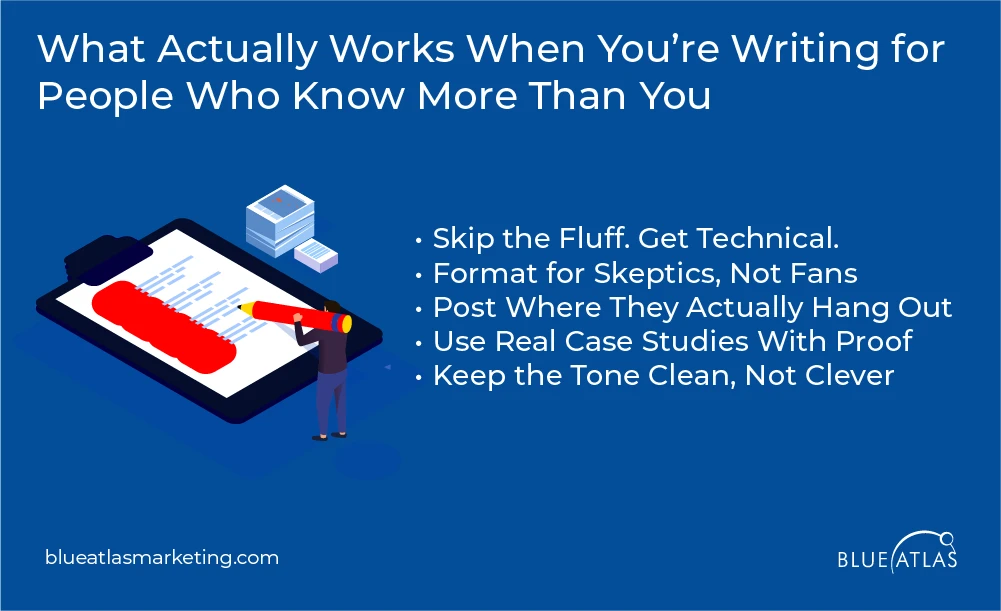
¨ Skip the Fluff. Get Technical.
- You’re not writing for generalists—you’re writing for people who build the product you’re marketing.
- Instead of summarizing, show the steps: diagrams, queries, benchmarks, actual performance data.
- Give them something they can test, not just read. Assume they’re smarter than your content team—and write accordingly.
¨ Format for Skeptics, Not Fans
- This audience doesn’t trust fluff, and they’re trained to debug everything—your marketing copy included.
- Use scannable formats: headers, bulleted lists, and TL;DRs up top. Include links to docs, repositories, or changelogs.
- If they can’t scan and learn something in 15 seconds, they’re gone.
¨ Post Where They Actually Hang Out
- Don’t expect them to find your blog buried in your footer.
- Republish and engage on GitHub Discussions, Hacker News, Reddit, and niche Slack or Discord communities.
- These aren’t “distribution channels”–they’re trust signals. Show up where real technical conversations are already happening.
¨ Use Real Case Studies With Proof
- Show, don’t tell. If you claim a 30% performance gain, share the repo commit or benchmark test.
- Walk through how a feature was implemented, not just what it “solved.”
- Let results do the convincing—and if you don’t have them, don’t publish yet.
¨ Keep the Tone Clean, Not Clever
- No buzzwords. No “solutioning.” Speak like someone who’s used the product, not sold it.
- Humility and clarity earn more respect in tech than polished marketing language ever will.
How to Make Content Google (and AI) Actually Wants
SEO isn’t dead. It just got smarter and a lot less forgiving.
Step 1: Start With the Funnel, Not the Topic
If you’re still writing random blogs based on keywords alone, you’re wasting your content budget.
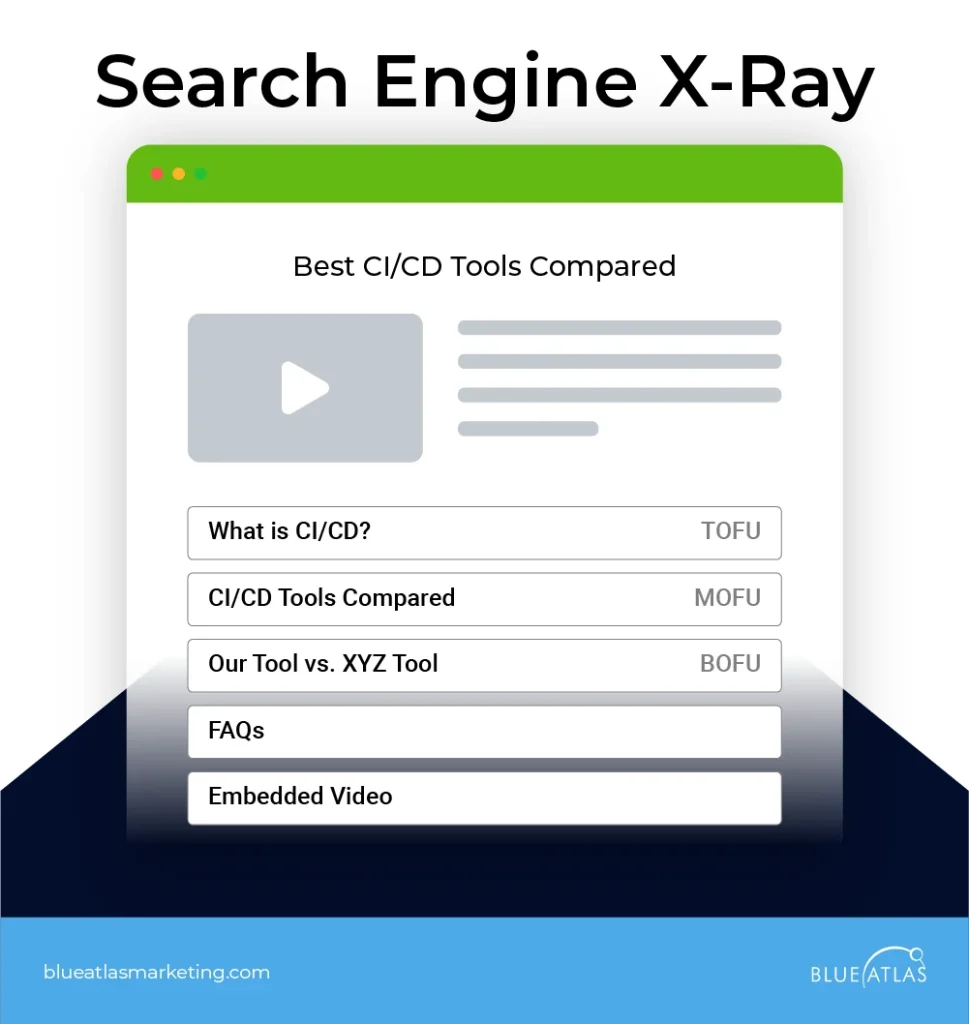
Instead, map each piece to a funnel stage: MOFU (middle-of-funnel) for buyers who are comparing, and BOFU (bottom-of-funnel) for those ready to decide.
A blog post about “best CI/CD tools” is TOFU.
A comparison guide between your tool and a competitor? That’s BOFU, and it converts.
Step 2: Build Deep, Structured Content—Not Word Count Filler
Forget 800-word blog posts. Build useful assets: full-page guides, multi-section explainers, embedded videos, visuals, and actual FAQ blocks.
The more your content looks like a resource (not a pitch) the more time people and search engines will spend with it.
Step 3: Mark It Up and Back It Up
If you’re not using schema, Google ignores your structure. Add it to your FAQs, product reviews, and comparison charts.
And backlinks? Prioritize earned ones from trusted domains–docs, directories, industry analysts–not spammy guest posts.
Social Media Trends and Their Impact on Brands or Companies
You don’t need to be on every platform; you need to be on the right one for the right reason.
Here’s how you do it:
| Process | What to Do | Social Platforms | Strategic Action |
|---|---|---|---|
| 1. Define Your Target Audience | Identify demographics, roles, behavior, and digital habits. | LinkedIn (B2B, professionals) YouTube (researchers, engineers) Instagram (creatives, early adopters) TikTok (younger tech-curious) Facebook (broader, aging) X (real-time, devs) | Use actual customer data—not assumptions—to build audience profiles. |
| 2. Match to Platform Demographics | Align audience traits with platform usage patterns. | LinkedIn (30–49, B2B) YouTube (18–55+, universal) Instagram (18–34, visual-first) TikTok (16–30, fast content) Facebook (35+, casual browsers), X (info seekers, real-time) | Prioritize platforms where your audience already spends time and actively engages. |
| 3. Fit Content Format to Platform | Choose formats that match each platform’s strengths and UX expectations. | LinkedIn (articles, carousels) YouTube (tutorials, demos) Instagram (Reels, Stories) TikTok (short-form video) Facebook (groups, short posts) X (threads, updates) | Don’t repurpose blindly–adapt the message and format for context and consumption behavior. |
| 4. Evaluate Ad + Targeting Options | Review how each platform handles segmentation and ad optimization. | LinkedIn Ads (job title/industry/company size) Meta Ads (behavior + interests via FB/IG) TikTok Ads (engagement-driven formats) YouTube/Google Ads (search + video intent) X Ads (broad reach) | Focus budget on platforms that allow surgical targeting, not just wide reach. |
| 5. Test and Iterate | Launch low-risk tests and let real data inform future efforts. | All platforms—test different ad formats, content types, and targeting logic to validate audience fit. | Drop what underperforms. Double down on what moves your funnel. Build your plan based on results, not trends. |
Email Marketing Innovations
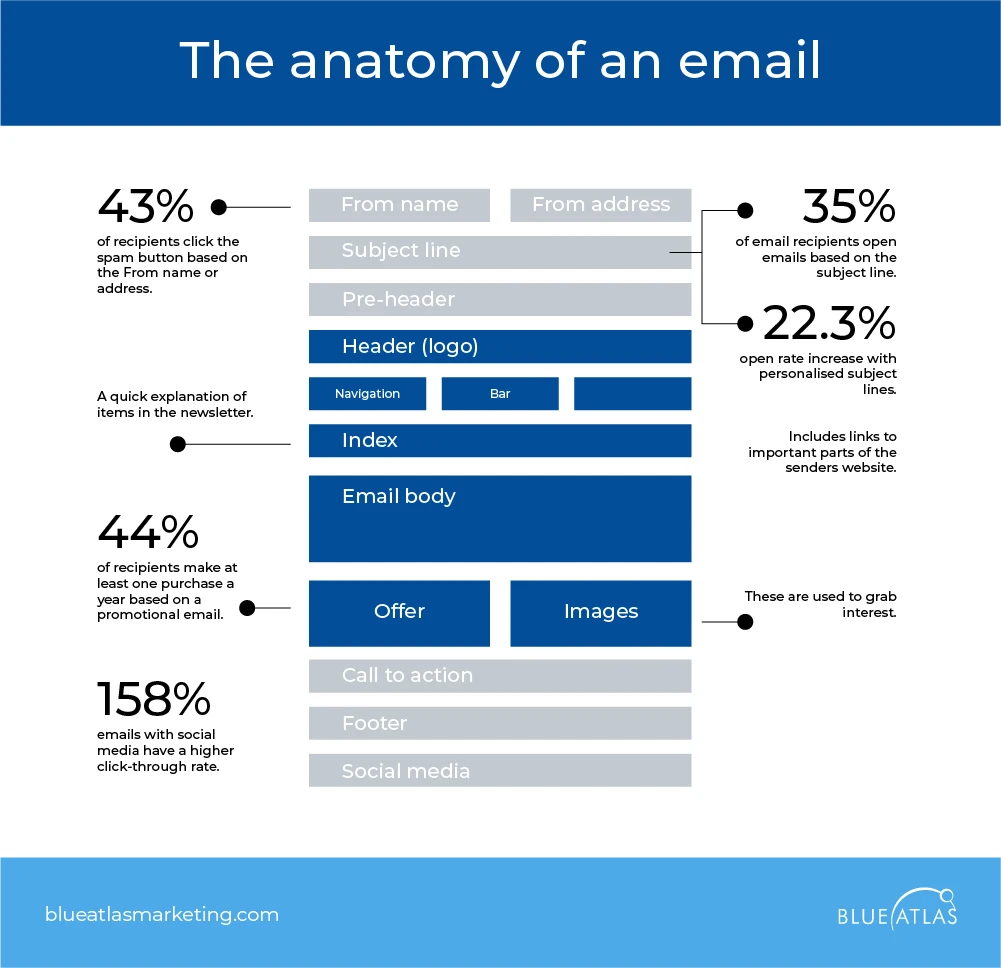
If your email still opens with “Hi {FirstName},” you’re not personalizing…you’re filling a template. Familiar?
To start, hyper-personalized subject lines go far beyond just dropping in a first name.
Mentioning a specific product interest or action, like “Still considering that cloud security toolkit?” is more likely to spark curiosity.
Campaign Monitor reports a 26% lift in open rates when subject lines are personalized this way. It’s a small tweak with an outsized effect.
Next, behavior-triggered emails make your outreach feel reactive instead of robotic.
When someone downloads a guide, views a pricing page, or abandons a cart, that’s your cue—not your calendar.
These moments carry more intent than a weekly blast ever could.
Then there are dynamic content blocks, which adjust the email body based on who’s reading.
A CTO and a junior dev shouldn’t see the same testimonial or case study. You can tailor messaging by persona, industry, even recent behavior–without rewriting the whole thing.
Timing matters too, which is where AI send-time optimization comes in.
Rather than guessing when to hit send, tools now analyze when each contact is most likely to open—and adjust accordingly.
One person gets it at 8:03 a.m., another at 9:12 p.m.—because that’s when they actually check.
Finally, segmenting by engagement level helps avoid blasting disengaged users with every email.
Someone who hasn’t opened the last five emails probably doesn’t need a product pitch, but might respond to a re-engagement campaign.
This keeps your sender reputation clean and your open rates healthy.
For all of this to scale without turning chaotic, automation tools are essential.
Platforms like HubSpot, ActiveCampaign, Mailchimp, and Brevo all offer the features you need to personalize without micromanaging.
If you’re comparing options or updating your tech stack, this article breaks down what’s worth your time.
Paid Ads That Don’t Burn Budget
If you’re not measuring real value from your PPC spend, you’re just renting clicks.
What Works in Paid Ads for Tech Companies
Free Trials Still Sell—If You Target Them Right
- For SaaS brands, offering a free trial or demo isn’t new. What matters is who sees the offer.
- Target decision-makers based on job title, company size, and intent signals—not just search volume.
- Google Ads, LinkedIn, and retargeting platforms are your best bets here.
B2B Tech Needs Qualified Leads—Not Clicks
- A high CTR doesn’t mean much if the audience isn’t right. B2B tech companies should focus campaigns around pain points (“cloud migration challenges”) and solution-driven keywords.
- The goal is to filter for buying intent, not curiosity.
Cybersecurity Is a High-Intent Vertical—Treat It That Way
- Cybersecurity buyers don’t click casually.
- Use high-intent, niche keywords like “endpoint protection for healthcare” and serve content with substance (comparison guides, compliance checklists, not fluffy ads).
- This audience knows what they’re looking for.
Green Tech Needs Visibility, Not Just Conversions
- New or mission-driven tech often needs to build trust before it can convert.
- Focus ad spend on awareness campaigns using video, explainer content, and brand-focused messaging.
- You can’t retarget what no one saw in the first place.
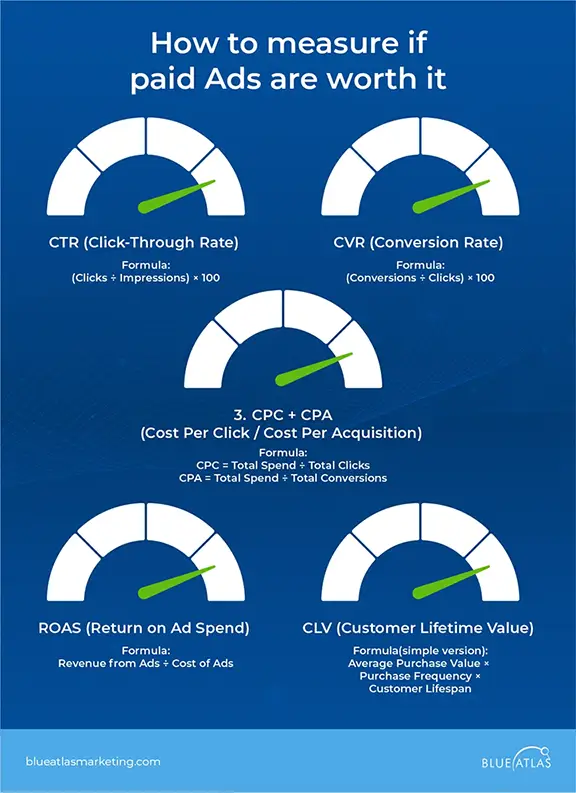
How to Measure If Paid Ads Are Worth It
- CTR (Click-Through Rate) – Great for testing hooks and creative, but not a reliable indicator of campaign success by itself.
A high CTR with low conversions often means you’re pulling the wrong audience.
Formula: (Clicks ÷ Impressions) × 100
- CVR (Conversion Rate) CVR shows whether your offer and landing page actually work.
If it’s low, your promise likely doesn’t match the post-click experience or something’s broken in the UX.
Formula: (Conversions ÷ Clicks) × 100
- CPC + CPA (Cost Per Click / Cost Per Acquisition) – CPC is what you pay just to get someone’s attention.
CPA is what you pay to get someone to act–sign up, demo, buy. Focus more on CPA, because clicks don’t pay bills.
Formulas:
CPC = Total Spend ÷ Total Clicks
CPA = Total Spend ÷ Total Conversions
- ROAS (Return on Ad Spend) – This is the revenue you get back for every dollar spent. Your CFO’s favorite stat.
If it’s below 1.0, you’re losing money.
Formula: Revenue from Ads ÷ Cost of Ads
- CLV (Customer Lifetime Value) – CLV helps you decide how much you can afford to pay for a single conversion.
High CLV means you can accept a higher CPA. It’s essential for subscription or multi-year contracts.
Formula (simple version): Average Purchase Value × Purchase Frequency × Customer Lifespan
Getting Other People to Talk About You (the Smart Way)
You don’t need a million followers, you need the right people saying the right things to the right audience.
Influencer and affiliate marketing both rely on borrowed credibility but how you manage them is totally different.
Influencers help you build trust, awareness, and momentum around launches.
Affiliates bring you consistent, performance-based traffic and conversions.
Both are worth using—but only if the fit is right and the execution is dialed in.
Here’s how they compare side-by-side, and what to do with each:
| Tactic | Influencer Marketing | Affiliate Marketing |
|---|---|---|
| Goal Setting | Start with a clear outcome–brand awareness, event buzz, or product hype? | Define performance-based goals like trials, conversions, or revenue share. |
| Audience Alignment | Vet followers based on demographics, behavior, and engagement–not just reach. | Match affiliates with niche traffic that aligns with your buyer persona and vertical. |
| Value Over Vanity | Prioritize creators with high engagement and content quality even if their follower count is lower. | Segment affiliates based on results (top performers, mid-tier, long-tail) and reward accordingly. |
| Platform Fit | Find them on YouTube, X (Twitter), LinkedIn, TikTok–based on where your target buyers are active. | Affiliates often work through blogs, review sites, and email lists. Different channels, same funnel. |
| Discovery Tools | Use tools like CreatorIQ, Modash, or Upfluence to find credible voices in your space. | Use platforms like Impact, PartnerStack, or ShareASale to manage and track affiliates. |
| Proof and Vetting | Check past campaigns, tone consistency, and brand fit. Screenshots aren’t stats, ask for real numbers. | Require transparency in reporting. Real-time analytics beat end-of-month spreadsheets every time. |
| Communication Style | Influencer relationships = human. DM, email, follow-up. Keep it personal. | Affiliate programs = scalable. Automate onboarding but stay available for top-tier partners. |
| Risk Control | Monitor messaging–your brand’s being spoken through someone else’s voice. | Prioritize fraud checks and compliance filters, especially if using open sign-ups. |
Performance Analysis and Adjustments
Marketing doesn’t need more opinions but more on better and faster data.
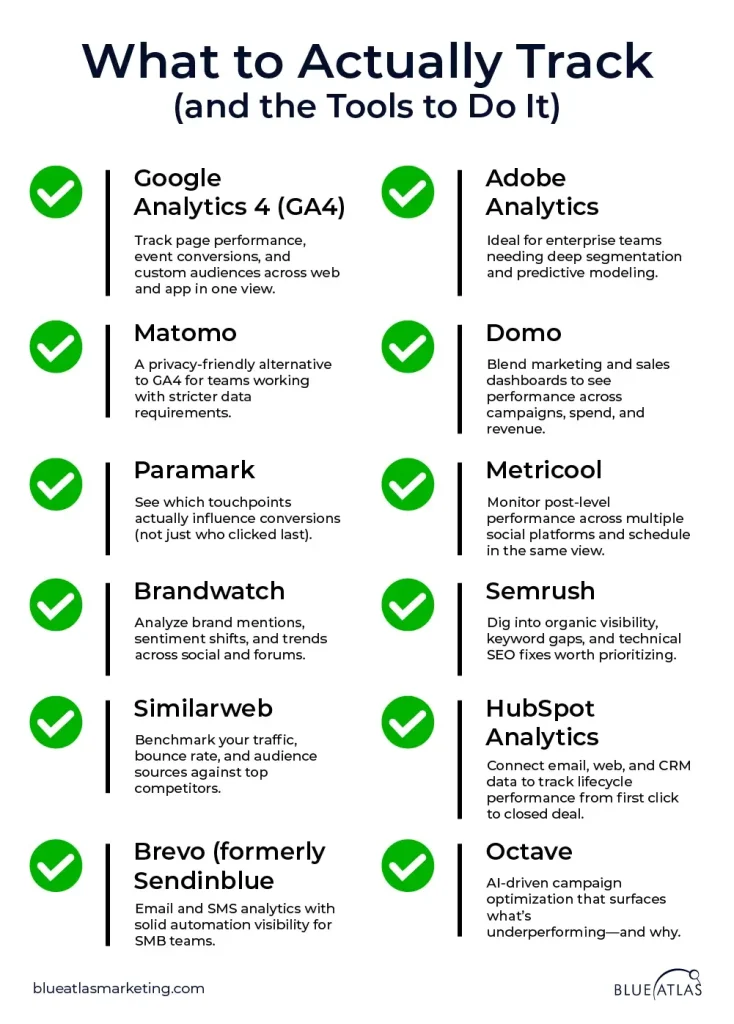
What to Actually Track (and the Tools to Do It)
Not every tool belongs in your stack. These do—because they tell you what’s working and what’s wasting budget:
Make the Data Work for You
Once you’re tracking the right stuff, it’s about reading the signals, not just watching charts move.
Look at the paths your best customers take, and use those insights to trim the fluff from future campaigns.
Don’t wait for quarterly reviews to make changes–adjust mid-flight.
Better data means better decisions, not bigger reports.
Frequently Asked Questions (FAQs)
What are the best digital marketing tools for tech companies in 2025?
Top tools include GA4, Semrush, HubSpot, and AI-powered platforms like Octave. These support essential marketing activities, helping tech companies streamline automation, track performance, and make data-driven decisions across multiple channels.
How can tech companies measure digital marketing success?
Success is best measured through metrics like ROAS, CVR, CPA, and CLV. These KPIs reveal how effective your digital marketing efforts are in driving conversions, improving retention, and maximizing return on spend.
Are influencers effective in B2B tech?
Yes—B2B influencers can reach decision makers when selected carefully. Focus on niche relevance, professional authority, and engagement to share insightful perspectives and establish credibility within specific tech verticals.
Is video content still worth investing in?
Absolutely. Video strengthens your content strategy, especially for demos, explainers, and walkthroughs. It improves understanding, builds trust, and encourages customer reviews that support both pre-sale education and post-sale satisfaction.
Can smaller tech firms compete with high-budget campaigns?
Yes—with a focused marketing budget, smaller firms can target the right audience, provide excellent customer service, and apply search engine optimization techniques to attract potential buyers even in competitive markets.
From AI-powered content to smarter email and PPC tactics, we’ve unpacked real strategies that elevate digital marketing for tech companies. These aren’t just trends—they’re best practices your marketing team can act on now.
By aligning efforts across social media channels and focusing on performance, you’re not just attracting potential customers—you’re building smarter campaigns that drive customer retention. What you have now isn’t noise—it’s a playbook built for real results in 2025 and beyond.
Ready to turn strategy into real results?
Partner with a digital marketing agency that delivers outcomes—not guesswork. Whether you’re targeting potential buyers or scaling big or small businesses,
Blue Atlas Marketing is built to drive growth.
Let’s get started. Contact us today.