
DIY Accessibility vs Hiring a Compliance Partner
An honest look at what doing it yourself really takes, where it works, where it breaks down, and how most government teams actually get compliant.


A capable team can handle parts of accessibility, especially keeping new content clean once they are trained. But bringing an existing government site to WCAG 2.1 AA, testing with assistive technology, remediating source code and PDFs, and producing a defensible record is specialized, time-consuming work. Most municipalities reach compliance fastest with a partner for the heavy lift and their own team for upkeep.
What DIY Actually Requires
Doing this in-house is not one skill, it is several. You need working knowledge of WCAG 2.1 AA, testing with screen readers like JAWS, NVDA, and VoiceOver plus keyboard-only navigation, developers who can correct markup and interactive components, someone who can remediate PDFs and documents, and the discipline to document every fix. Automated tools help, but they catch only about a third of issues, so the rest depends on people who know what to look for. The 2026 WebAIM Million study found detectable WCAG failures on 95.9% of the top one million home pages, which is a fair measure of how hard this is to get right without specialists.
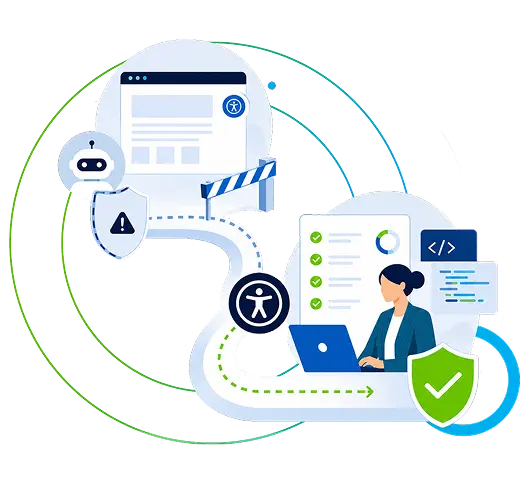
DIY vs a Compliance Partner
|
Factor |
DIY in-house |
Compliance partner |
|---|---|---|
|
Expertise required |
Your team must learn WCAG, AT testing, and PDF remediation |
Specialists already have it |
|
Testing |
Usually automated only, unless you have AT testers |
Manual testing with assistive technology |
|
PDFs and documents |
Often skipped for lack of tools and time |
Remediated directly |
|
Time to compliance |
Long, and competes with day-to-day work |
Weeks to months, focused |
|
Defensible documentation |
Rarely produced |
Standard, ready for leadership or OCR |
|
Ongoing upkeep |
A natural fit for trained staff |
Covered by a monitoring program |
|
Cost profile |
Lower cash cost, high staff time and risk |
Clear project cost, lower risk |
|
Risk if done wrong |
Non-compliant with a false sense of security |
Verified, with a record to show it |
Where DIY Works
In-house effort pays off in a few places. Keeping new content accessible once staff are trained, so you stop adding barriers. Small, simple sites with light document loads. And basic fixes a competent developer can handle. If your team learns to publish accessible pages and documents, you prevent a large share of future problems at almost no cost.
Where DIY Breaks Down
The trouble is the existing backlog and the hard parts. Testing the way a screen reader user experiences the site takes tools and training most teams do not have. Remediating a deep library of untagged PDFs is slow, specialized work. And producing documentation that would hold up in front of the Office for Civil Rights is not something most in-house teams have done before. This is where DIY quietly stalls and the deadline creeps up.
The Hybrid Most Cities Use
In practice, the strongest approach is a split. A partner handles the initial audit and the heavy remediation, including the code and the documents, and trains your team to keep new content clean. A monitoring program catches regressions over time. You get to compliance quickly and hold it without carrying the entire burden in-house.

Our Honest Recommendation
For most municipalities, the fastest, lowest-risk path is a partner for the lift and your team for the upkeep. That is how we work: our specialists audit and remediate the site and the documents, prove the fixes, and train your staff so the site stays accessible after we hand it back. If your site is small and simple, we will tell you honestly that you may be able to handle more of it yourselves.
Frequently Asked Questions
Can free tools get us compliant?
They help you find some issues, but automated tools catch only about a third, and they do not fix anything. Real conformance needs manual testing and remediation.
Isn’t DIY cheaper?
The cash cost is lower, but it consumes staff time, usually skips PDFs, and risks leaving you non-compliant. Factor in the time and the risk before calling it cheaper.
We have a developer on staff. Is that enough?
A developer can implement fixes, which is valuable, but WCAG conformance also needs accessibility expertise and assistive-technology testing to know what to fix and to prove it.
What can we realistically do ourselves?
Keep new content accessible, maintain good structure, and handle simple fixes. Lean on a partner for the audit, the backlog, the PDFs, and the documentation.

Find the right split for your team
Start with a free scan to see the size of the job, then talk with us about what makes sense to keep in-house and what to hand off.